It was that time again: the Magento community in the Rhein-Main region met for the 53rd edition of the Stammtisch. This time, e3n had invited us to Mainz, and the premises were kindly provided by Thiele & Klose GmbH.
What particularly pleased me: the Stammtisch was really well attended. Some participants had also traveled a long way. This shows that the format and the opportunity to exchange ideas in person remain extremely valuable.
A big thank you in advance for the catering too. There was delicious food and drinks – something I certainly do not take for granted these days. Suitably refreshed, we moved on to the evening's two main topics.
Performance Tuning from a Hosting Provider's Perspective
Jonas Hünig from maxcluster kicked things off. His topic, "Performance Tuning for Magento", is a perennial favorite, but Jonas chose a very interesting angle: the hosting provider's perspective.
Slow shop instances are frustrating – for customers, merchants, and developers. Jonas showed how to systematically track down and analyze typical bottlenecks. I particularly liked that the presentation was not designed as a pure sales pitch for maxcluster. The diagnostic methods and server service settings were presented in a way that also works for hosting outside maxcluster.
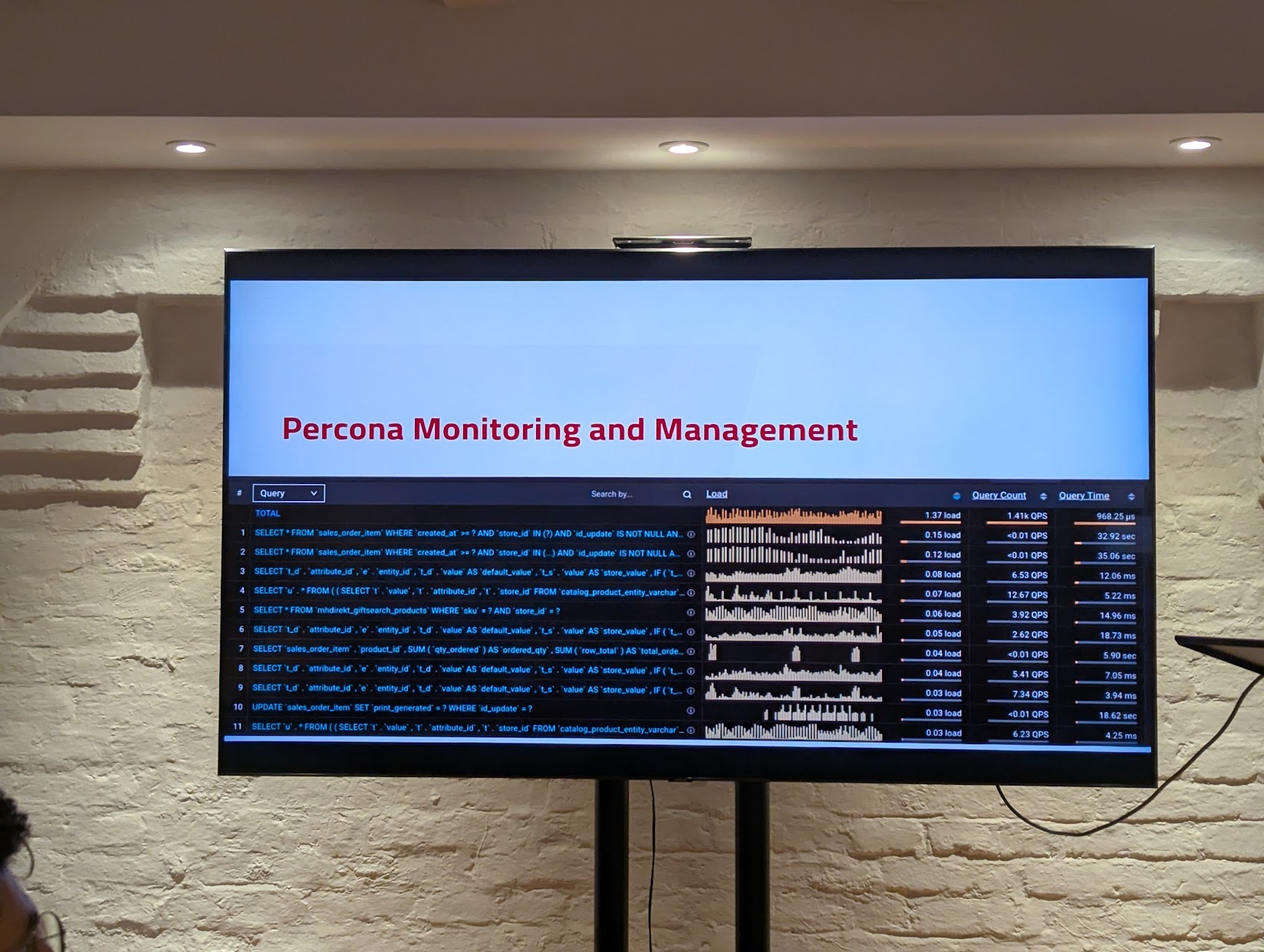
The talk went gratifyingly deep into the technology: Jonas also discussed Linux kernel-specific optimizations and demonstrated the use of strace for analysis live. Personally, I really enjoyed this very technical deep dive.
Of course, "on top" there were also some insider insights into maxcluster's particular setup and how certain problems can be solved even more efficiently there.
A small highlight on the side: maxcluster brought a small gift for every participant. Thank you for the lovely little LED lamp! It has already found its place in my home and has been set up.
Hype or Real Change? How AI Is Changing Coding
The second speaker was Tobias Niebergall from e3n. His presentation tied in seamlessly with topics that have occupied me intensively here on the blog over the past few weeks. Under the title "Hype or Real Change? How AI Is Really Changing Coding", he explored the term vibe coding.
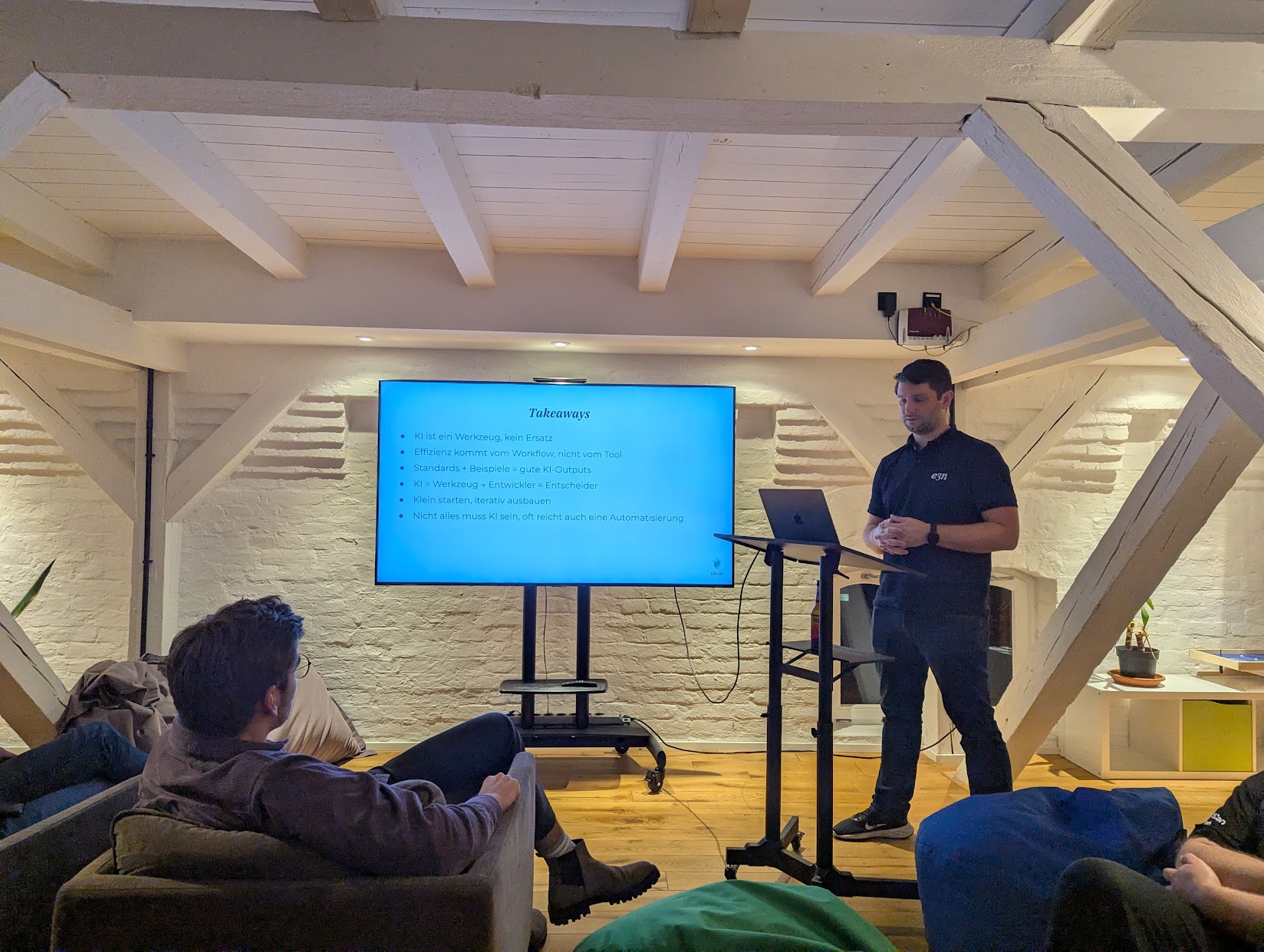
Tobias showed that AI-assisted development is much more than just code completion. It is about building smart workflows. Using tools such as Claude, MCP servers (Model Context Protocol), and n8n, he demonstrated how to make your development team more productive. Security in connection with AI tools was also discussed.
The key points were practical:
- How do I use AI in a targeted way to stay in the "flow"?
- Automating repetitive tasks (something I can only confirm from my experiments with agents).
- How to turn ideas into working prototypes and solutions much faster.
The goal was to help the developers in the room overcome their reservations and show ways to gradually integrate AI into their everyday work.
Wild Discussions to Wrap Up
As you would expect from a good Stammtisch, the evening was far from over after the presentations. Tobias's talk in particular struck a chord with the times and sparked a substantial discussion.
The topics ranged across the board:
- Training: Are junior developers still learning to code properly if AI takes over everything?
- Software quality: Is the code getting better, or are we flooding our repositories with AI-generated spaghetti code?
- Sustainability: What does the CO2 footprint actually look like when we fire up an LLM for every little function?
- Security & WAFs: The use of Web Application Firewalls was also discussed. Björn Kraus had valuable tips on working with
mod_securityand pointed out that many of these best practices are already implemented in his Magento Helm chart (see also: modsecurity-crs-proxy).
It was – in the best possible sense – pretty wild. But that is exactly what makes a Stammtisch for me: different opinions, passionate debates, and going home with fresh inspiration at the end.
Thank you to e3n, Thiele & Klose, maxcluster, the speakers, and everyone who attended. It was a successful evening!