Disclaimer: The following blog post expresses my personal opinion, subjective perception, and memories. It makes no claim to completeness. The text was written entirely by me, without AI. A perfect chronology is not the priority.
The beginning
I have always been a big fan of open source and have always felt at home in the Magento community. In the past, I invested more time in contributing code to Magento Open Source, which used to be called Magento Community Edition. At the beginning, there was no documentation. You were forced to look directly at the code to understand how something worked. Later, there was a series of training videos in which I first became acquainted with Ben Marks, who later worked as a Magento evangelist. Even before the first Magento version, 0.8 Beta, I had the opportunity to work on a shop at netz98 that was meant to replace a TYPO3 installation with the Commerce extension. Back then, Magento was the open-source shop system setting out to fill a gap. I still remember my apprentice at the time, Daniel, showing me Magento and pointing out that it was based on the Zend Framework. Since we were having problems with the TYPO3 system and could not explain to the customer very well how product management worked, we decided to give Magento a chance here—which later turned out to be a really good decision.
The choice of free shop systems was also very limited at the time. There were systems such as OS-Commerce. Magento 1, for example, still had code to make migrating from OS-Commerce easier. It was a real flourishing of the open-source world in e-commerce, since most systems were closed source. Magento was about to make a rapid ascent.
At the beginning, the company "Magento Inc" (previously Varien Inc.) did not make any money, and at some point a secret investor appeared, who quickly turned out to be PayPal, because all you could see was a logo in the admin configuration under payment methods. That was (deliberately) not well hidden. For the Magento world, X.com was also something different back then from what it is today.
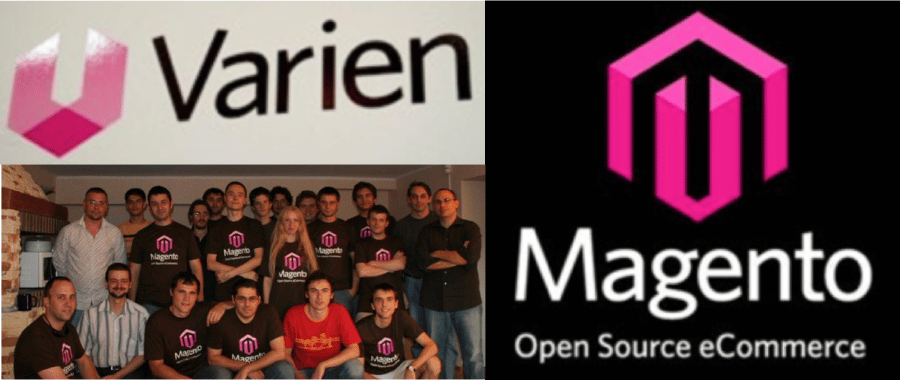
The first Magento logo was still magenta in color.
The image shows the Varien team.
At some point, Magento Enterprise came onto the market. Back then, Magento simply could not scale well. Shops would regularly suddenly have no products because the price index or category index had broken yet again. The Enterprise Edition helped here, introducing an asynchronous index and the Full Page Cache. That was also the main selling point for an Enterprise Edition at the time.
But back to the community...
You had the impression that everything had been waiting for Magento. Something emerged that left many people amazed. The Magento community was born. Although Magento development took place largely in Ukraine and Magento Inc. was a US company, the nucleus of the Magento community was in Germany.
Meet Magento emerged as a central event held in Leipzig, Germany. Despite its name, it was organized not by Magento Inc., but by the agency netresearch and other committed individuals such as Rico Neitzel. Most recently, TechDivision organized the format in Leipzig once again.
Later, Meet Magento became an international event series held in many other countries too. The Magento community has always been international and very friendly. That is one of the Magento community's fundamental strengths. It gave rise not only to collaborations and products, but also to friendships.
Businesspeople met idealists, and it worked.
Many other formats emerged too (I am certainly forgetting some), such as Magento meetups, developer conferences like Mage Titan, Mage-Test-Fest, hackathons, contribution days, tools, and hosting solutions. Social events were created as well, such as MageRun, launched by the athletic Brent Peterson, which I hope to take part in someday.
Magento Imagine also introduced an official international event. Almost all the other events had essentially been organized from within the community (apart from the Magento Live series later on). That was really very special, and perhaps even unique.
And what e-commerce system is so popular that people join together in an association such as Firegento to support it privately? Something like that existed—and still exists—only with Magento.
Magento 2
Magento 2.0 brought the first major break in the ecosystem. To this day, there are developers who still feel more at home in the Magento 1 world, for example with forks such as OpenMage. We have Ebay Enterprise to thank for Magento 2 existing at all, because at one point, stopping its development and continuing with Magento 1 was under consideration.
I entered the Magento 2 bubble very quickly myself, because at the time I had the opportunity, along with just a few colleagues (including Matthias Walter and Rouven Rieker), to migrate the SEAT merchandising shop from Magento 1 to Magento 2 (Case Study - YouTube Video). Those were exciting times, since Magento 2 was still very unstable and we had to change the development version several times during development. The shop then went live as the first Magento 2 Enterprise shop in Europe. I am still a little proud of that.
At the time, I also had the opportunity to attend the first official Magento 2 training in London together with Matthias Walter and Rico Neitzel, where we had the honor of being trained directly by Vinai Kopp.
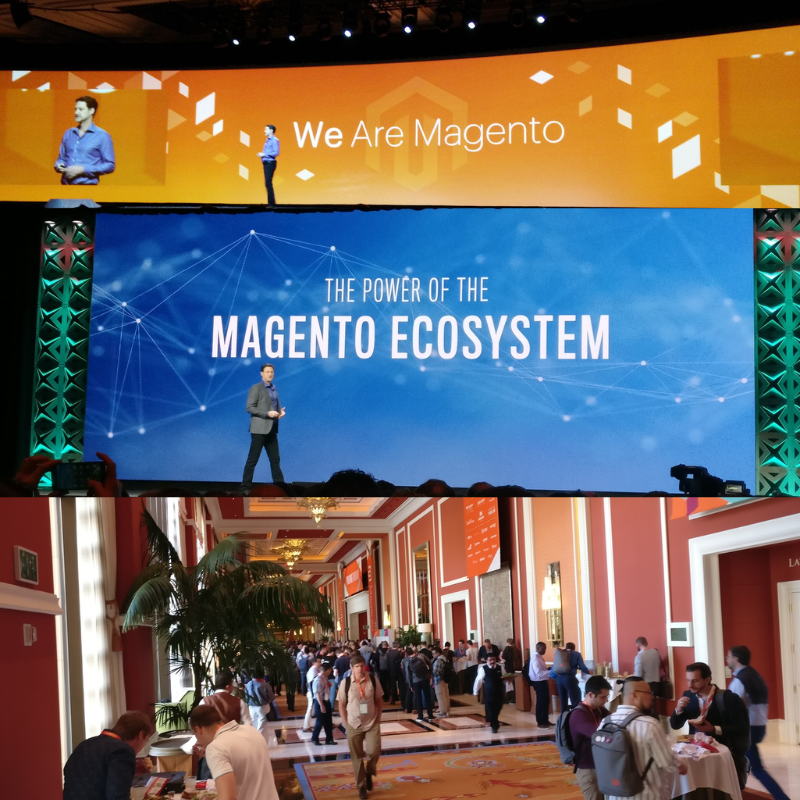
Magento Imagine was the largest Magento-only event.
While others were still working with Magento 1 for a long time, I was involved with Magento 2 right from the start. Because of the quick success, we also had to train many developers on Magento 2 at netz98 sooner than expected. To acquire the knowledge myself, I then ported n98-magerun to n98-magerun2. Initially, the idea was to put Magento 2 support into the same tool. But that quickly turned out to be a bad idea, since the codebases were very different. It was not an update, but a re-platforming. At first, the Magento code team had simply used a tool to convert the old class names (which followed the Zend standard) to PHP namespaces. That meant I could initially just map class names (Mage_Catalog_Model_Product to Magento\Catalog\Model\Product). But that soon ended as the codebase was then restructured.
And so n98-magerun2 was born. Both tools still exist today.
n98-magerun2 1.0.0 was released on the same day as Magento 2.0. There was also a great release party in Mainz, in a specially rented area of the football stadium, with a live link to Magento Live in Australia.
I am now skipping a few years and moving straight to the next major change: Adobe's acquisition of the Magento brand (there had been several owners in between).
Since I am—and was at the time—the head of development at one of the first Magento Gold Partners, engaging with the new owner, Adobe, was a given.
The Hyvä Theme enters the market
When Adobe acquired the Magento system, it naturally also took over the tech stack, core developers, and architecture. Changes soon followed in various places. For example, the location in Ukraine where the main development took place was shut down. Important developers were brought to the USA.
At that time, PWA was also a very prominent topic. Headless architectures, in which the backend and frontend run as separate applications, were emerging too. To this day, the terms and technologies PWA and headless are often mixed up.
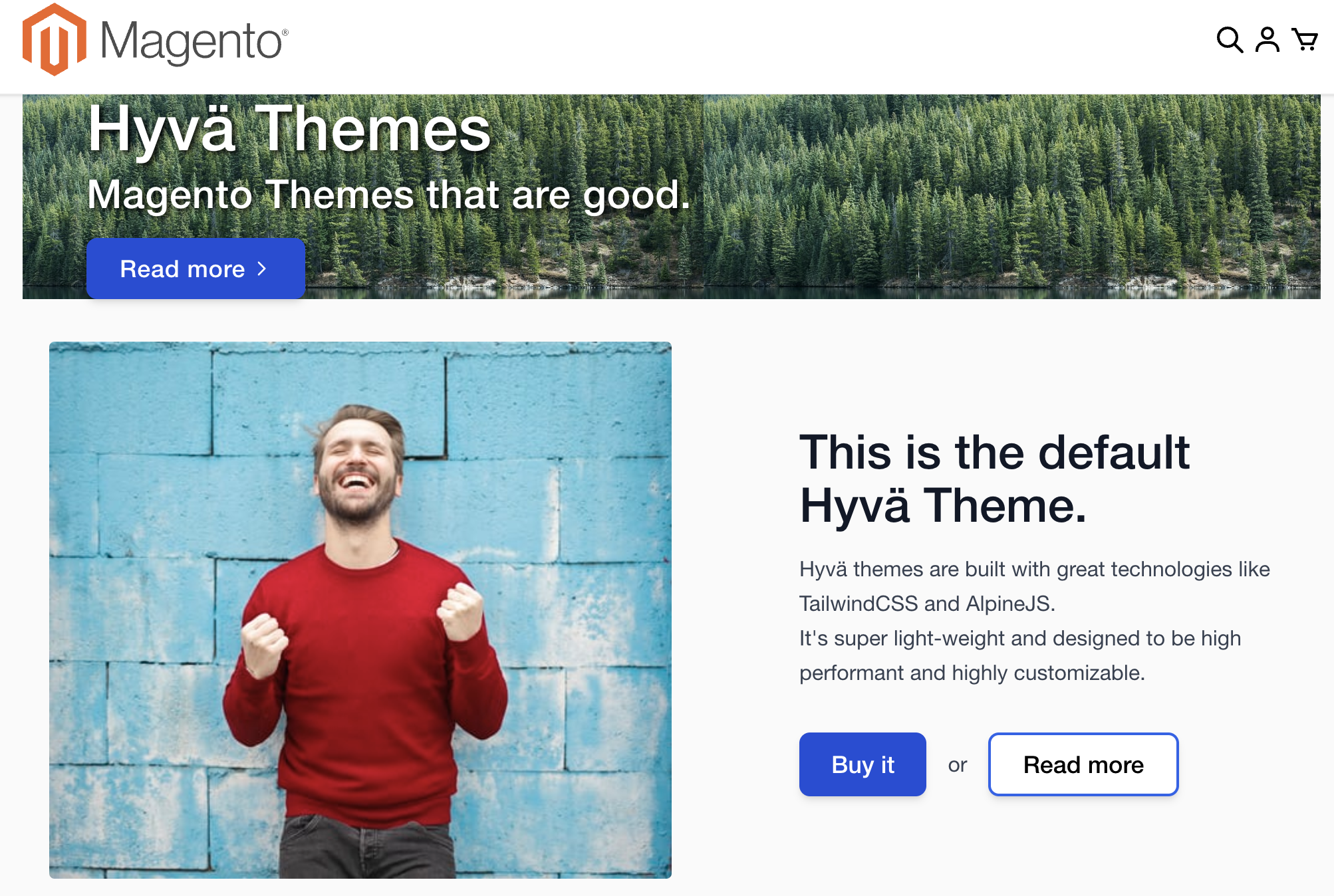
This is what the Hyvä Theme demo looked like in 2020
For Magento, this trend meant that new frontend solutions appeared on the market. At netz98, we got involved with Vue Storefront very early on and also ran tests with the official PWA Studio. I was never a big fan of PWA Studio myself. Adobe, which also offers a standalone CMS solution with Experience Manager, was itself one of the drivers of this new architecture. The new architecture promised frontend developers more freedom to choose the latest frameworks.
From that point on, little love was invested in the standard Magento frontend, now commonly referred to as Luma. There were also statements that the Luma frontend was "deprecated," which were then denied again. But it was clear that Luma would be on its way out.
Many developers did not feel at home in the new headless/PWA world, which brought a new player into the market.
That new player was Hyvä. Behind Hyvä was Willem Wigman, a young and dynamic developer who expressed his opinions assertively. The Hyvä project was also supported by the German company integer_net, where Willem was employed for a time.
Hyvä itself quickly became successful. With the new Hyvä Theme product, the old Luma stack with jQuery and RequireJS was replaced by a more modern stack. The goal was developer happiness and more frontend performance. At netz98, we were involved very early because we also saw major advantages in the new stack. The new frontend stack accelerated development, and the websites' Lighthouse scores were much better too. In addition, the deeply nested block structure in Magento's layout was simplified.
In the meantime, netz98 has become part of valantic, and the company has become a Hyvä Gold Partner.
Hyvä is now much more than a software studio developing a theme. More on that later.
Mage-OS emerges
Adobe itself does not seem to have had much experience with open-source software when it acquired Magento. I even think it underestimated the acquisition of a company with open-source software and the corresponding ecosystem. It was never the case that Magento Inc. was especially communicative. But Magento Inc. was a little more approachable than a corporation like Adobe. You could even speak directly with the boss.
At Adobe, everything felt (purely subjectively) a little less transparent. I think we in the Magento world also have a somewhat rose-tinted view and tend to suppress some of the bad things. For example, there was no software documentation for many years. Companies such as Adobe (or ebay before it) also brought a fair amount of structure that had a positive effect on development. Overall, though, it was not very transparent. To this day, links to internal Adobe systems are posted in public Github issues. On Adobe's side, developers then work on fixing bugs, which is a great thing. But you do not see any of what is happening and only get to see something once it is finished. Adobe has been aware of this situation for years. Little has changed, though. That is partly simply down to the large organization.
The community's coordination process only helps a little, too. Anyone who has ever submitted a pull request can confirm that. Everything is a bit over-engineered, and you are initially overwhelmed by all the automated quality assurance measures. I can handle that myself. For new developers, though, it is certainly much more difficult.
Open-source developers want to participate in development. This applies especially to further development. Developers want to see new features in the software and contribute code themselves. Some good, and some nerve-racking, discussions arose about the further development of Magento Open Source. I can only reproduce fragments of the entire sequence here and am deliberately leaving some information out.
Many discussions, with and without the Magento Association—which had also been introduced in the meantime—led to an open letter on the future of Magento, signed by over 1,600 people (including me) from the Magento ecosystem. The decisive factor behind this letter was Adobe's initiative to increasingly scale back further development within the Magento monolith. Further developments were then to take place outside the monolith. The fading visibility of the Magento brand was also an important reason, as Adobe redirected magento.com to the Adobe website.
All of this, along with the desire to be able to release a software distribution without a vendor, led to the Mage-OS fork. Many people from the Magento community whom I greatly respect gathered around Mage-OS. But there were also some who kept their distance. It felt like a break, too.
At the beginning, one goal was to make it possible to install Magento (Mage-OS) without depending on a Composer package server operated by Adobe (with authentication).
Mage-OS achieved this technical goal.
A less technical goal was to bring back the spirit of the Magento community. Some of what made the Magento community special had been lost. Many freelancers had turned their backs on Magento and sought their salvation in other shop systems.
The Mage-OS logo still has Magento's colors
For me, it was clear that n98-magerun2, for example, absolutely had to be compatible with Mage-OS (which it currently is). Since version 1.0.6, Mage-OS is now a distribution that, for the first time, also makes changes to the framework that are not included in Magento Open Source. This reveals the first tentative differences in a codebase that is largely identical to Magento Open Source.
By now, the sometimes heated discussions around Mage-OS and the Magento brand have calmed down considerably. People are sitting at the same table with the Magento Association and Adobe and have found a way of working together. Adobe continues to invest a not-insignificant amount of money in maintaining the Magento Open Source codebase.
Mage-OS now acts as a kind of bleeding-edge software distribution into which new features are also flowing. The admin theme has been adjusted. New features are being developed that are not aimed at "Enterprise." There is now a web installer, for instance. Features can be included that Adobe would not put into the system.
Magento Enterprise has since become Adobe Commerce. Nevertheless, a complete Magento Open Source installation with all its modules is still inside every Adobe Commerce installation.
Magento can now once again be found as an open-source system at https://magento-opensource.com/.
At the same time, there is great content on both the Mage-OS website and at Adobe itself. Developers have never had so much documentation available. So things are looking up again.
The questions occupying me now are these:
- In what direction is the ecosystem developing?
- Is there even one ecosystem, or are there not already two ecosystems?
- What role does Hyvä play?
- In what direction is Adobe developing the system landscape?
I have found answers for myself. The future will show whether I am right.
The Adobe (Commerce) ecosystem
I do not operate exclusively in the purely open-source world myself. That is simply due to my professional environment. In my work, I have always dealt with other structures. Early on, for example, I worked with Microsoft SQL Server or Oracle databases that were not open source. In the past, I also developed Windows software myself. So I know the world of closed and compiled software too.
In e-commerce, too, I have always worked with closed systems. That is not a contradiction for me. As a developer, it is my decision whether I want my software to be open or closed. Personally, though, I simply find the open-source idea more appealing. Open source does not always have to be free of charge, either. If we are honest, we have a major problem with funding open-source software.
Today, SaaS often plays an important role too. These are mostly closed systems, and their operation is a black box as well. So you no longer see any of the software. We already had SaaS solutions like this in the past. But different terms were used. Terms such as cloud or serverless functions (which I think is an awful term) did not exist. Even so, there were already service-oriented landscapes and the term client/server back then. Systems have always been decoupled in large system landscapes. Anyone who has worked in IT for a long time will keep seeing the same principles under different names.
Since I have repeatedly worked with these kinds of systems professionally, and still do, I can also understand Adobe's view of these landscapes well.
Very often, it is about processes, standardization, and scaling. It is about keeping update costs low. Plans are made for a global infrastructure. Everything is simply a little bigger in enterprise structures. There is a difference between running a small online shop on a server, perhaps with a staging system as well, and having perhaps 20 instances in which many people and systems interact. Decisions are also driven by large consulting firms. That applies to Adobe's customers as well as Adobe itself.
Adobe Commerce Enterprise Reference Architecture. Source: Adobe
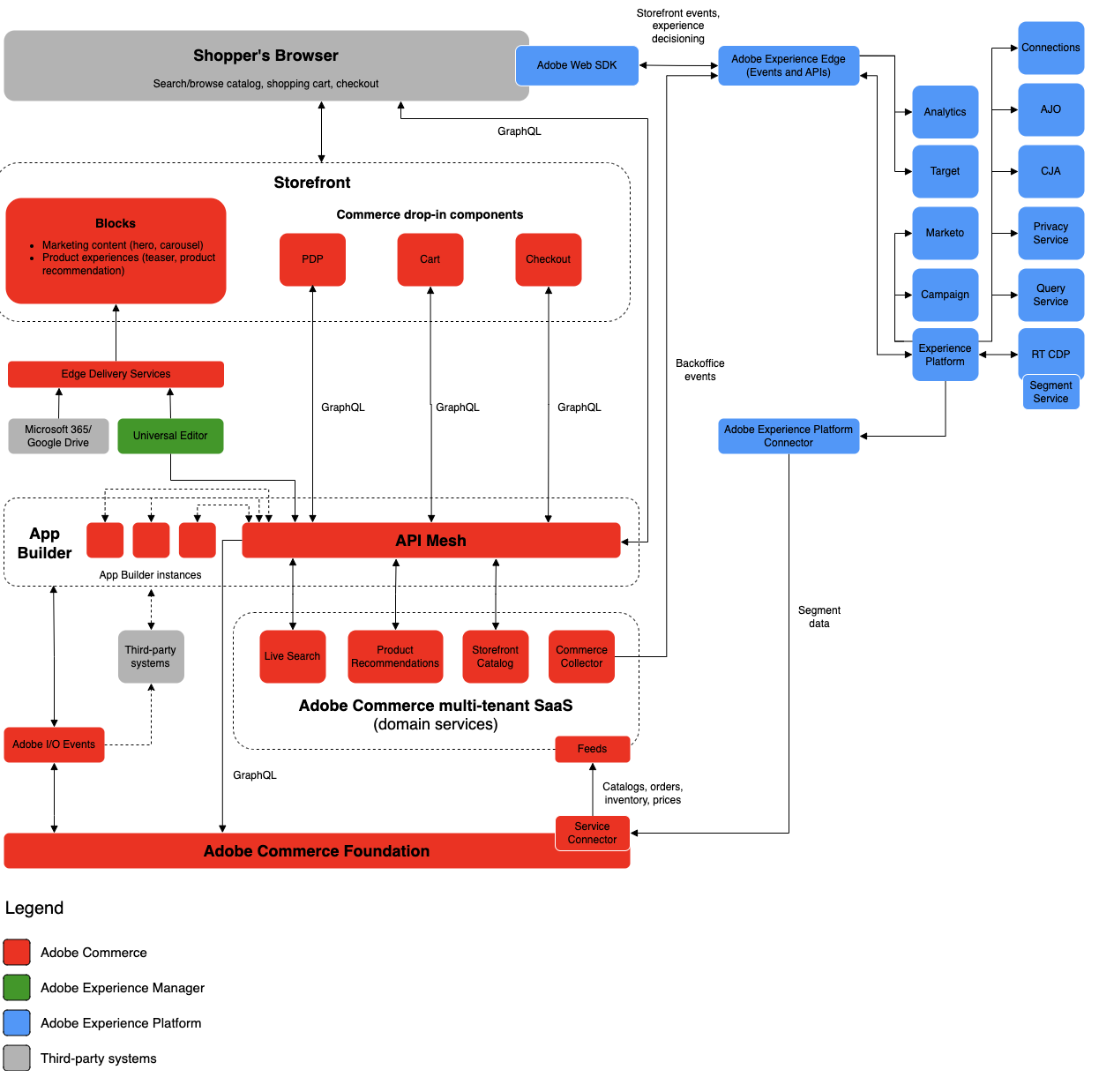
The perspective changes with the intended objective. Adobe offers several hundred products in various areas. As an ordinary Magento developer (that is not meant disparagingly), you can quickly feel lost. First, you have to understand what each product is actually responsible for. There are consultants just for that alone. Is the product relevant to me, and what advantages does it offer? What does introducing a product cost? Are there alternatives?
This also raises the question of why Adobe bought Magento. In my opinion, the answer is very simple. Adobe did not have a product in the digital commerce space. It therefore needed a product to offer a solution for the increasingly important area of customer experience as well as e-commerce.
At that point, Adobe itself was already very well positioned in content management with products such as Experience Manager Site and Experience Manager Assets. Products such as Adobe Target and Adobe Analytics for personalization and tracking were already available.
Adding an e-commerce system to the portfolio was urgently necessary to be able to serve customers comprehensively.
Since there was a certain amount of time pressure, a system simply had to be acquired.
Magento was a system available on the market at that point. Some of Adobe's competitors had also gone shopping in the market and bought systems. The difference, however, was that those were not open-source systems. That was certainly something very special for Adobe too. At almost the same time, Adobe also acquired Marketo (yes, it has a very similar name). Since Marketo was already a SaaS solution, there were no discussions around the open-source ecosystem there as there were with Magento.
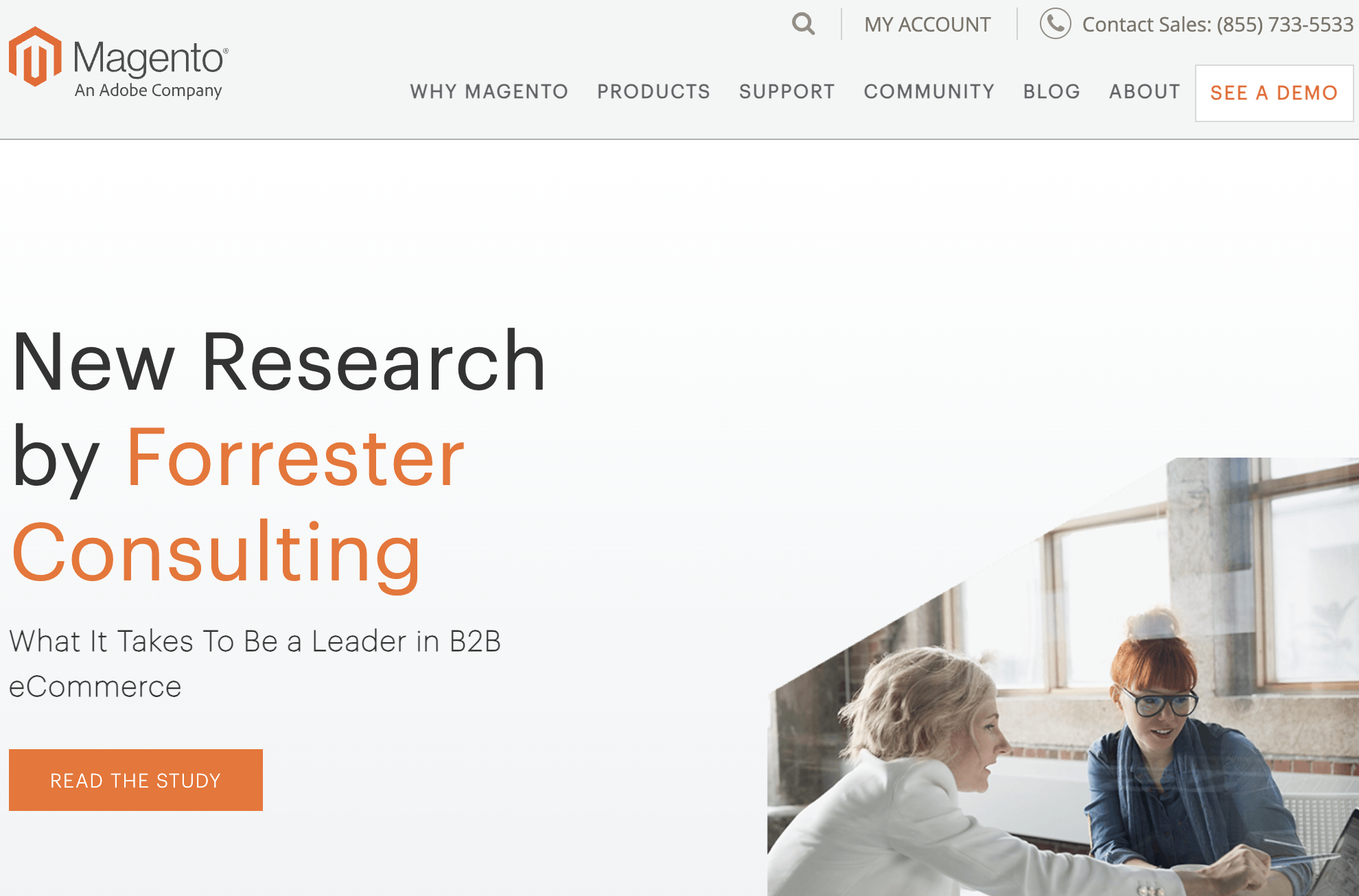
At first, Adobe's acquisition was only visible on magento.com through the slightly adjusted logo.
So Adobe bought not only software, but also an ecosystem comprising many developers, agencies, and integration providers. This made it significantly faster to enter the market with the acquisition and reach more customers.
To present the product world a little more clearly, products were sorted into different product families, all with names ending in "Cloud."
Magento, or Adobe Commerce as it is called today, was placed in Adobe Experience Cloud, alongside other suitable products such as Target and Analytics and the then still fairly new Adobe Experience Platform.
Adobe Commerce is a product within Adobe Experience Cloud
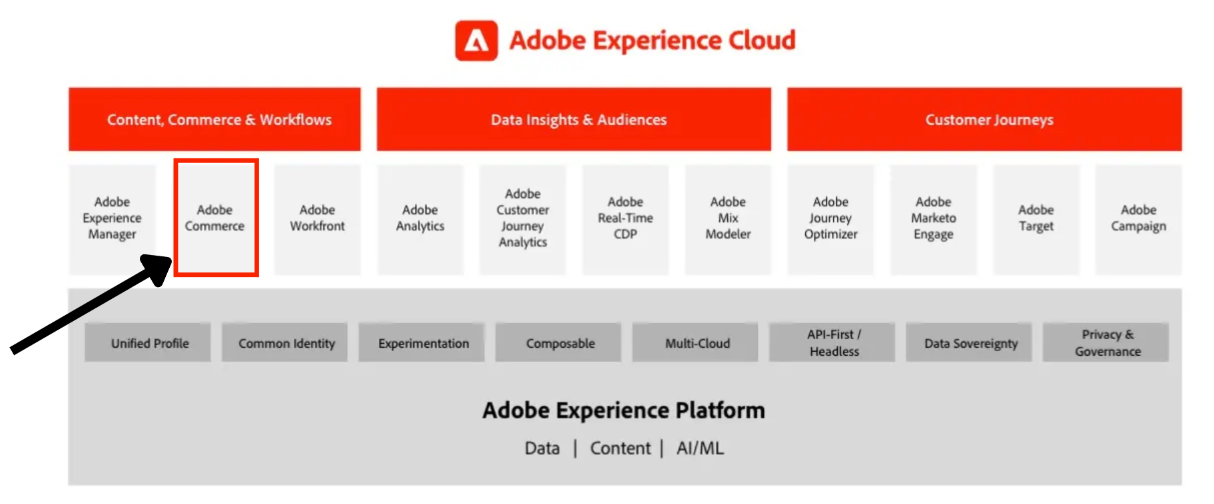
Since Adobe offers specialized products, it stands to reason that it would integrate as many of them with one another as possible. This is exactly where the ecosystem differs. While the world viewed through the Magento lens tries to pack as many functions as possible into a monolith, the Adobe world tries to cover everything through specialized systems.
For Adobe, this works very well when it has complete control over the software. That is the case with SaaS solutions. Here, a vendor can quickly make changes to the underlying software and create integrations with its own products faster too.
But how can I, as a customer or agency, then make changes? Only in a world based purely on standards are there no changes. Somehow, though, a company's business model has to be able to differ. In the real world, there are simply differences in processes. So there must be some way to make individual customizations to the software.
One of Adobe's answers here is Adobe App Builder. It allows small applications based on NodeJS to be published directly as SaaS. Ideally, these applications communicate with the other systems (which need not be from Adobe either) only through APIs.
Each of these small applications can be viewed as a microservice. And there you are, in the monolith-versus-microservice discussion.
This is exactly where the heated discussions that do not really lead to a result come from. Camps have formed, and sometimes people are comparing apples and oranges.
As I wrote at the beginning, I feel at home in both worlds myself. Depending on the use case, one or the other fits. There is simply no single approach that is always right.
Where a simple Magento system is sufficient for a small merchant managing a shop with a handful of employees, others with a global business and perhaps many people maintaining content have completely different requirements for a solution.
But it is already clear to me that we already have two different ecosystems, and that they will drift even further apart in the future, both technologically and ideologically.
My advice here is to try looking through both sides' lenses to understand their decisions better. You have to decide for yourself where to position yourself. One question for me is also whether I can continue to operate in both worlds.
Is Hyvä the new Magento Inc.?
I keep asking myself whether Hyvä will become the new Magento Inc. Looking at the history, Magento developers are searching for stability and direction. They are looking for an approachable company where they can still speak with the decision-makers. In retrospect, not everything that glittered at Magento Inc. was gold. But you had the impression that you were noticed as an individual developer or a smaller agency.
Hyvä is now more than just a theme vendor. There are solutions for merchants and agencies. It is compatible with Adobe Commerce too.
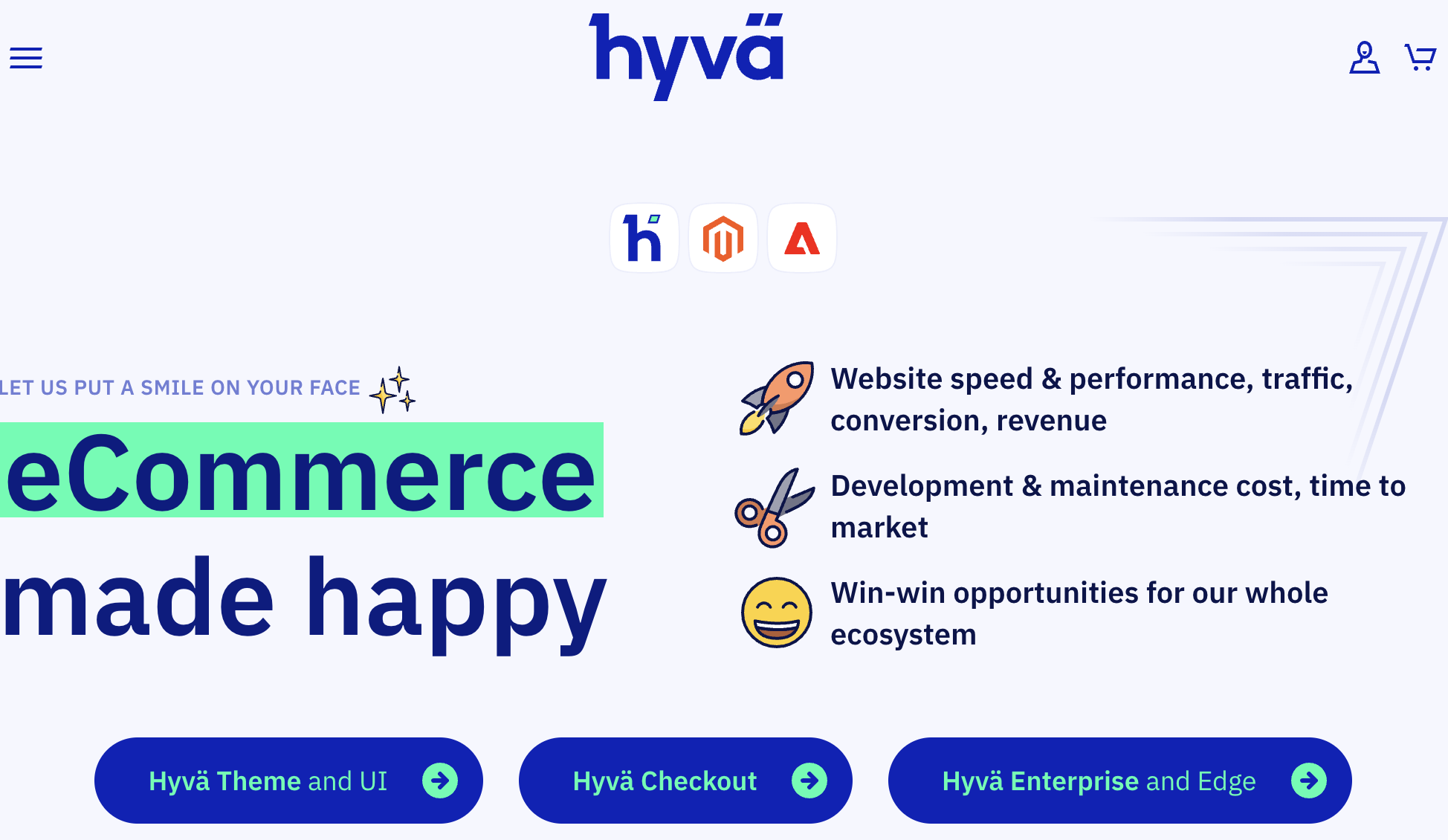
For me, that was only a somewhat important reason, since I have never worked at a really small agency myself. But I hear this from others and can understand it.
This is precisely where Hyvä could fill a gap, and it certainly has the best chances of doing so.
With the announcement of the new Hyvä Commerce, it is moving very strongly in this direction. The Hyvä Theme product is viewed largely positively by developers and agencies. With its own Hyvä Commerce (Magento distribution?), it is getting closer to what Magento Inc. used to be.
A company that develops the Magento monolith and steers it in a direction. Perhaps it will not always go in the direction you personally like, but it will be going in a direction, and there will be an entity driving goals forward. And you can talk to the people at Hyvä.
Hyvä has increasingly become a voice for Magento community developers who still like working on the monolith with PHP code. Not every developer wants to make themselves dependent on a corporation such as Adobe. Looking at the pace at which Hyvä is spreading in the market, the goal is also clearly defined. With the introduction of Hyvä Commerce, and perhaps later with Mage-OS as its basis, it is completely independent.
Hyvä is already a driving force at all Magento community events.
Equipped with strategic partners and an already very experienced group of people who have made a name for themselves in the Magento world, everything looks good for the future. The "developer shop" Hyvä is growing into a serious player that may someday be present in the market as an e-commerce solution of its own. The future will tell.
A conclusion? What happens next?
We can only guess where the Adobe / Magento / Mage-OS / Hyvä world is heading. To me, there are already two ecosystems that complement and overlap with each other in certain areas. But they will become more distinct in the future.
For me, 2025 remains very exciting, and I will certainly write another post about further developments. So there is no final conclusion. Everything is work in progress.
What is noticeable, though, is that there is significantly more going on in 2024 and 2025. That applies to Adobe as well as the entire Magento ecosystem, which has awakened from its sleep and self-pity. People are recognizing their strengths again and offering solutions on the market.
There are also significantly more Magento events, such as a Hyvä Developer Paradise and various Meet Magento events. The Magento meetups have found their feet again too.
After a break of several years, there will also be a Meet Magento Germany again in 2026.
In any case, I am looking forward to everything that is coming...
PS: If you are looking for fond memories of Meet Magento, you should take a look at Flickr. There are some nice photo albums there: https://www.flickr.com/photos/meet-magento/albums