When we look at developments over the past two years, we often feel as though we are on an express train that barely stops at stations. But based on current analyses and observations, a fundamental shift is emerging for 2026: we are leaving the phase of pure experimentation ("Wow, ChatGPT can write poetry!") and entering the phase of operational value creation.
The common denominator for 2026 is autonomy – no longer just digitally on our screens, but increasingly physically in our real world too. Let us take a detailed look at what this means for us as developers, e-commerce experts and data scientists.
Physical AI: Intelligence gets a body
A decisive turning point for 2026 is the rise of "Physical AI". While we have mainly known AI as a chatbot or image generator until now, intelligence is now leaving the screen and manifesting itself in the physical world. It is the convergence of advanced AI with hardware – from industrial robots to consumer devices.
Embodied intelligence instead of rigid programming
Robots are evolving from "dumb" machines that stubbornly follow programmed paths into intelligent actors. Thanks to advanced models, they perceive their surroundings through sensors and make decisions autonomously. We are talking about embodied intelligence: robots no longer act merely as tools, but as autonomous agents that solve real problems.
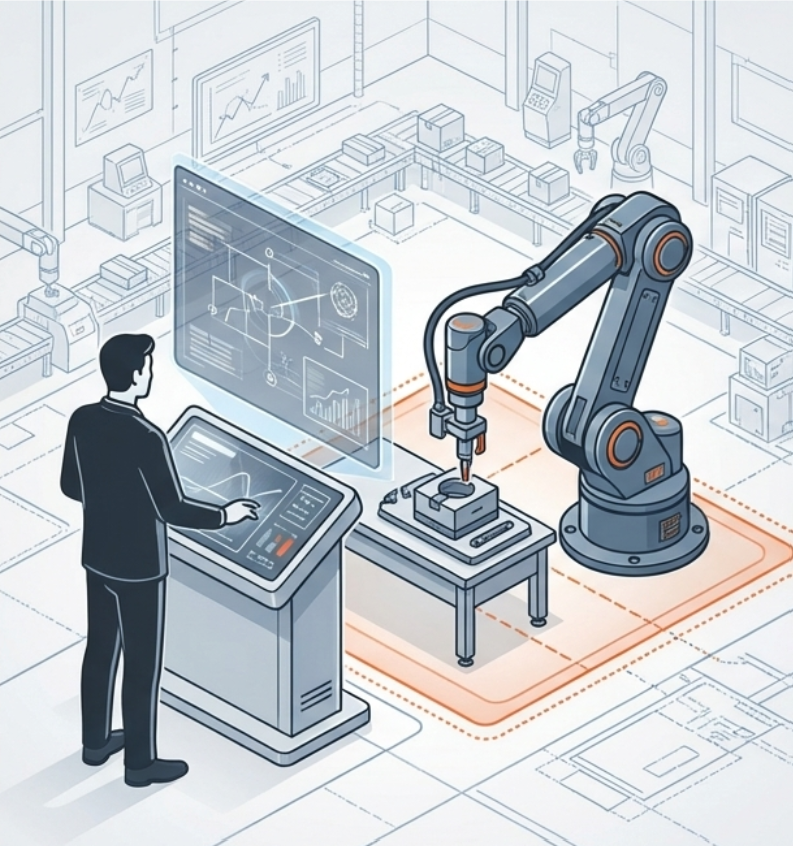 (Image source: Google AI)
Examples include Amazon's "DeepFleet" AI, which coordinates enormous fleets of robots, or BMW factories where vehicles navigate through production on their own. This is about "Vision-Guided Assembly", where systems react to deviations in real time rather than stopping at every error.
The era of collaborative automation
In 2026, the old fear of being displaced by machines gives way to the concept of human-machine teams. We are seeing the rise of "collaborative automation":
- Division of tasks: Robots (cobots) take on routine, dangerous or physically demanding tasks.
- Human focus: We humans concentrate on strategy, creativity and complex customer relationships.
- Safety: There is an enormous focus on "fail-safes" so that these autonomous systems can work safely side by side with us.
A revolution in logistics and new industries
The impact is felt across industries:
- Logistics & warehousing: Autonomous Mobile Robots (AMRs) are becoming standard in distribution centers. They bring items directly to pickers and drastically reduce idle time. These fleets are controlled directly by e-commerce data to sort millions of orders.
- Phygital B2B: In B2B commerce, the physical and digital worlds merge. For example, robots stock smart lockers so that tradespeople can collect their orders around the clock.
- Agriculture: Autonomous drones monitor fields and spray pesticides only where they are really needed, increasing yields and protecting the environment.
- Energy: Drones inspect wind turbines or power lines to minimize risks to people and detect faults earlier.
Technical enabler: To make all this work in real time, computing power moves directly into devices via Edge AI. The programming language Rust is gaining enormous importance here because it provides the memory safety and performance needed for these critical systems.
IoT 2026: From a sensor network to an autonomous nervous system (AIoT)
In 2026, the Internet of Things is no longer a loose network of connected sensors. IoT merges fully with artificial intelligence into AIoT or Physical AI. Devices no longer just collect data; they make autonomous decisions directly where it originates (the edge).
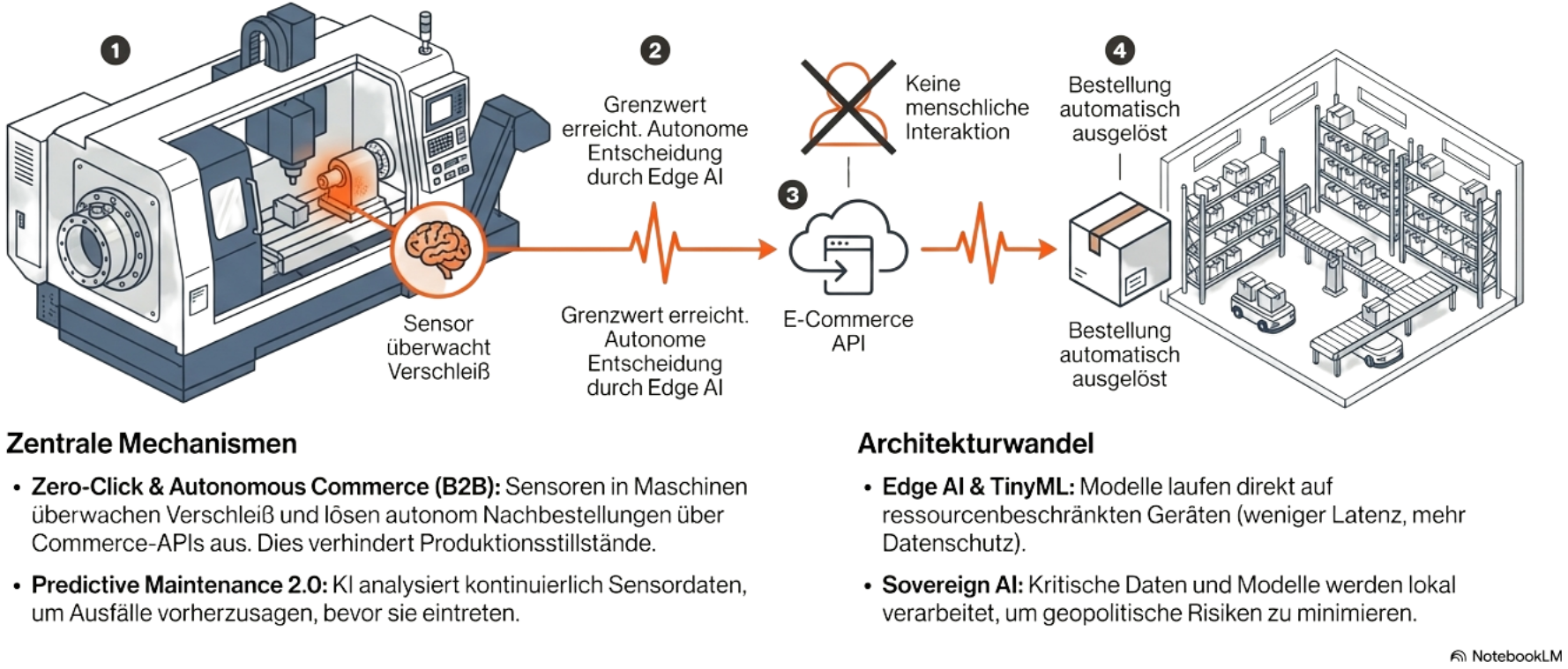
From data collection to action: Zero-click & autonomous commerce
IoT systems become active market participants:
- Autonomous reordering (B2B): Sensors in warehouses, machines or production lines monitor stock levels and wear, automatically triggering orders through commerce APIs when needed – without human intervention. This reduces inventory costs and prevents production downtime.
- Predictive Maintenance 2.0: AI continuously interprets structured and unstructured sensor data to predict failures before they happen. In industries such as energy supply or manufacturing, this makes manual inspections largely unnecessary.
Edge AI, TinyML & distributed MLOps
The cloud loses its monopoly:
- Edge AI & TinyML: Models are optimized to run on resource-constrained devices. This reduces latency, saves bandwidth and improves privacy because data does not need to leave the device.
- Distributed MLOps: Model deployment, updates and monitoring are distributed across thousands or millions of devices.
- Rust as a key technology: For embedded and IoT systems, Rust is establishing itself as the preferred language because it combines performance with strong memory safety.
The expansion of Physical AI: Robotics & drones
IoT becomes mobile and autonomous:
- Autonomy across industries: IoT-controlled robots and drones independently carry out inspections, transportation or field analyses – from logistics and agriculture to healthcare.
- Warehouse automation: Fleets of AGVs and AMRs, controlled by IoT and real-time data, become standard to cushion labor shortages and rising order volumes.
Hardware and energy constraints
The expansion of AIoT runs up against physical limits:
- Legacy chip shortage: Older chip technologies in particular (>90 nm), essential for IoT devices and industrial facilities, are coming under pressure – a risk for scaling and availability.
- Energy efficiency: Energy-efficient computing becomes mandatory. Neuromorphic approaches and specialized inference chips address rising electricity demand.
Security & sovereign AI in IoT
As IoT increasingly controls critical processes, security becomes a system-level issue:
- Sovereign AI: IoT data and models must be processed locally (data residency) to minimize regulatory and geopolitical risks.
- Preemptive cybersecurity: AI-based security systems predictively detect attacks before they can cause damage.
In short: In 2026, IoT is the nervous system of autonomous agents. It not only supplies data, but independently performs physical actions such as ordering, maintenance or transportation directly on the device.
Consumer hardware: From training to inference in everyday life
An often underestimated but central trend for 2026 is the shift in consumer hardware. While recent years primarily focused on chips for training large AI models, demand is now shifting significantly toward inference – the efficient application of AI in everyday life.
From training chips to inference machines
For end-user devices, what matters is not maximum computing power at any cost, but energy efficiency, low latency and real-time availability. AI responses have to arrive immediately – without a round trip to the cloud. This leads to a new generation of chips specifically optimized for inference that can continuously run AI features in the background.
On-device AI as the standard
Companies such as Qualcomm are pushing this development forward aggressively. "On-device AI" means AI runs directly on smartphones, laptops or wearables – even offline. This brings several advantages:
- Privacy: Sensitive data does not leave the device.
- Cost control: Less cloud inference reduces ongoing operating costs.
- Performance: Speech, image or gesture recognition responds without noticeable delay.
This development is the key to AI truly becoming an invisible everyday companion – rather than just a cloud API.
Energy-efficient computing as a field of innovation
At the same time, pressure is growing to curb IT's appetite for energy. Alongside traditional chip optimizations, new paradigms are emerging:
- Optical computing: Computing operations using light promise drastically lower energy consumption for certain workloads.
- Neuromorphic systems: Chips that mimic the human brain work on an event-driven rather than clock-driven basis – ideal for sensing, pattern recognition and edge applications.
Even if these technologies are not yet widespread in the consumer market in 2026, they point the way for the next decade.
The smartphone as a biometric fortress
In mobile commerce and digital identity, the smartphone becomes the central security authority in 2026. Hardware takes on tasks previously handled through passwords and manual checks.
- Biometric standards: Fingerprint and facial recognition become basic requirements for seamless wallet-first payments and logins. Passwords and manual card entry increasingly disappear from everyday life.
- Real-world object detection: Improved cameras, LiDAR and depth sensors enable smartphones to identify real objects precisely and embed digital content accurately into the physical environment.
For commerce, this means authentication, payment and context merge into a single hardware-supported process.
Smart home & connected devices
In the home too, hardware becomes the natural interface between people and digital commerce.
- Voice commerce: Smart speakers, wearables and connected household appliances evolve into active shopping assistants. Orders are placed contextually by voice – without an app, without a screen, with minimal interaction steps.
In summary: consumer hardware in 2026 is defined by AI specialization (inference chips), autonomy and natural interaction through biometrics, speech and spatial understanding.
At the same time, pressure is growing to curb IT's appetite for energy. Alongside traditional chip optimizations, new paradigms are emerging:
- Optical computing: Computing operations using light promise drastically lower energy consumption for certain workloads.
- Neuromorphic systems: Chips that mimic the human brain work on an event-driven rather than clock-driven basis – ideal for sensing, pattern recognition and edge applications.
Even if these technologies are not yet widespread in the consumer market in 2026, they point the way for the next decade.
AR & VR: The interface between the digital and physical worlds
In 2026, AR and VR reach a level of maturity that makes them broadly usable for the first time – beyond gaming and marketing demos too.
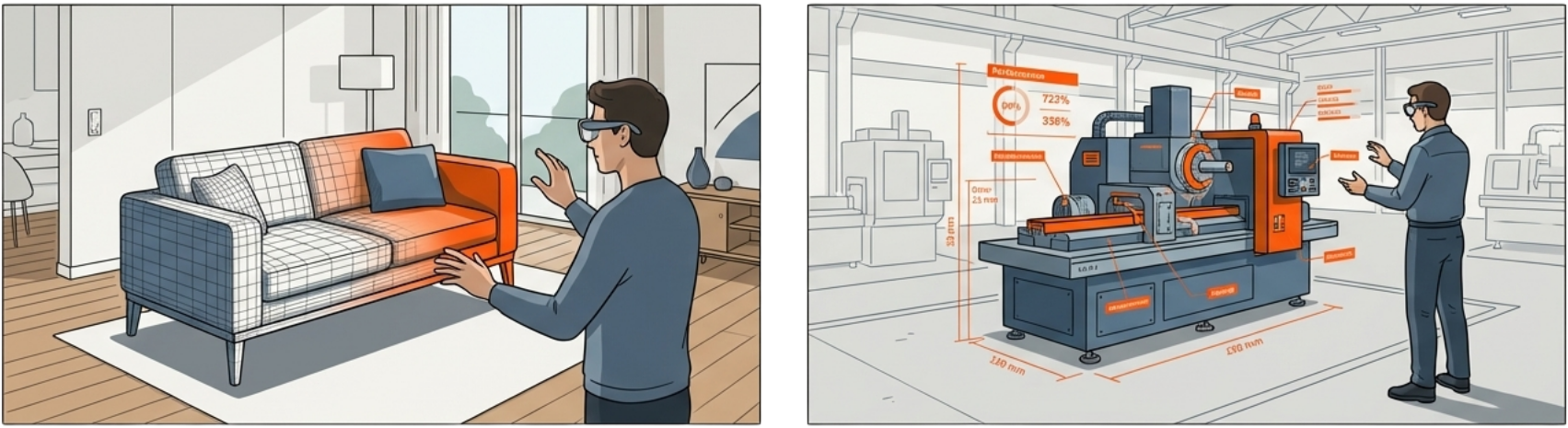
New forms of interaction
Interaction moves away from traditional controllers:
- Gesture and gaze control
- Head movements
- Natural voice commands
This makes AR/VR more intuitive and inclusive – while also linking it more closely to AI systems that understand context and intent.
Rethinking shopping & e-commerce
Specific use cases emerge for (B2B and B2C) commerce:
- Virtual try-ons: Clothing, glasses or protective clothing are realistically visualized on your own body.
- In-home visualization: Furniture or machines can be placed in your own space at true scale.
- Real-time advice: AI-powered assistants guide users through immersive shopping experiences.
AR/VR thus becomes not a gimmick, but an interface that matters for sales between product data, space and the customer.
See also E-commerce Trends 2026: 10 Insights for the Future of Online Shopping
The hardware crisis of 2026: Shortages, energy and geopolitics
Alongside all these innovations, a structural hardware crisis is emerging for 2026 – not as a one-dimensional shortage, however, but as a complex interplay of misguided investment incentives, energy scarcity and geopolitical risks.
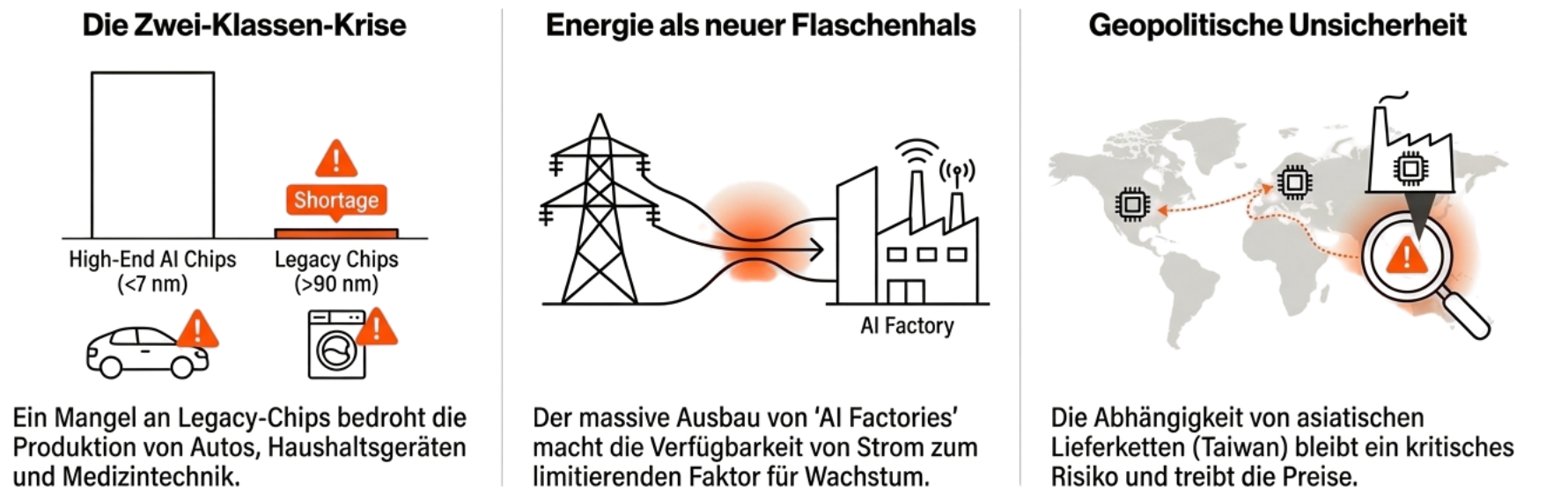
The two-tier chip crisis
The crisis is driven less by a lack of high-end AI chips than by a shortage of so-called legacy chips.
- Everyday technology under pressure: While massive investments have gone into cutting-edge manufacturing for AI and smartphones, production of mature technologies (above 90 nm) has lagged behind – precisely the chips needed by cars, household appliances and medical technology.
- Consequences: Production stoppages in the automotive industry become more likely. A worldwide decline in vehicle production of up to 20% is considered a realistic scenario, with longer delivery times and rising prices for end customers.
Energy as the new bottleneck
The hardware crisis is increasingly becoming an energy crisis.
- AI factories: The massive expansion of data centers drives electricity demand to a new level.
- Costs & scarcity: The availability and price of electricity become the limiting factor for growth.
- Countermeasures: Companies are forced to shift AI computations in time – for example through carbon scheduling, where inference runs when energy is available or inexpensive.
Geopolitical uncertainty as a price driver
Dependence on global supply chains remains critical:
- Dependence on Asia: A large proportion of companies see geopolitical tensions surrounding Taiwan as a serious threat to semiconductor supply.
- Price increases: Most companies are already facing rising chip prices – costs that are passed on to end customers.
Delivery delays as the new normal
Even without escalation, the situation remains tense:
- Average delay: Around four months of lead time for semiconductors is considered normal.
- Planning uncertainty: A significant share of companies rates the supply situation for 2026 as critical.
The essence: The crisis is not arising because there is no technology, but because the wrong technology was prioritized for a long time. This intensifies the political and economic focus on energy infrastructure, resilience and sovereign supply chains.
Green AI: Sustainability as an architectural decision
Sustainability in 2026 will be shaped by an interesting duality. We face the challenge of managing AI's enormous energy appetite itself (Green AI) while also using AI as a tool to become more sustainable (AI for Sustainability).
The balance: Green MLOps & carbon scheduling
Sustainability becomes an integral part of Machine Learning Operations (MLOps). We developers no longer optimize solely for a model's accuracy, but seek the trade-off between performance, costs and the CO2 footprint. Green metrics become central KPIs.
Carbon scheduling will be a major topic: AI workloads are scheduled to run when there is plenty of renewable energy available on the grid or electricity is inexpensive. Because energy availability can become a bottleneck for data centers, companies will be forced to diversify their energy sources.
Data for the circular economy
AI becomes a driver of genuine business value through sustainability.
- Scope 3 transparency: Since sustainability data is effectively business data, companies use AI to track complex indirect emissions along the entire supply chain (Scope 3). (See also https://www.scope3transparent.de)
- Digital product passport: Regulatory requirements force CSOs (Sustainability Officers) and CDOs (Data Officers) to work closely together to manage the flood of data for product passports.
- Competitive advantage: In B2B e-commerce, transparency about the CO2 footprint or material origins becomes a genuine competitive weapon. Those who provide this data transparently win contracts.
To avoid the so-called rebound effect – where more efficient AI simply leads to even greater use – companies will introduce stricter rules for using AI tokens. AI computing power will only be approved when significant added business value can be demonstrated.
E-commerce trends 2026: Autonomy, platforms and data sovereignty
E-commerce enters a new phase of maturity in 2026. Less manual shopping and more automation, autonomy and system intelligence shape the market. At the same time, a clear countertrend emerges: the desire for control over data, costs and infrastructure.
Agentic commerce: When bots go shopping
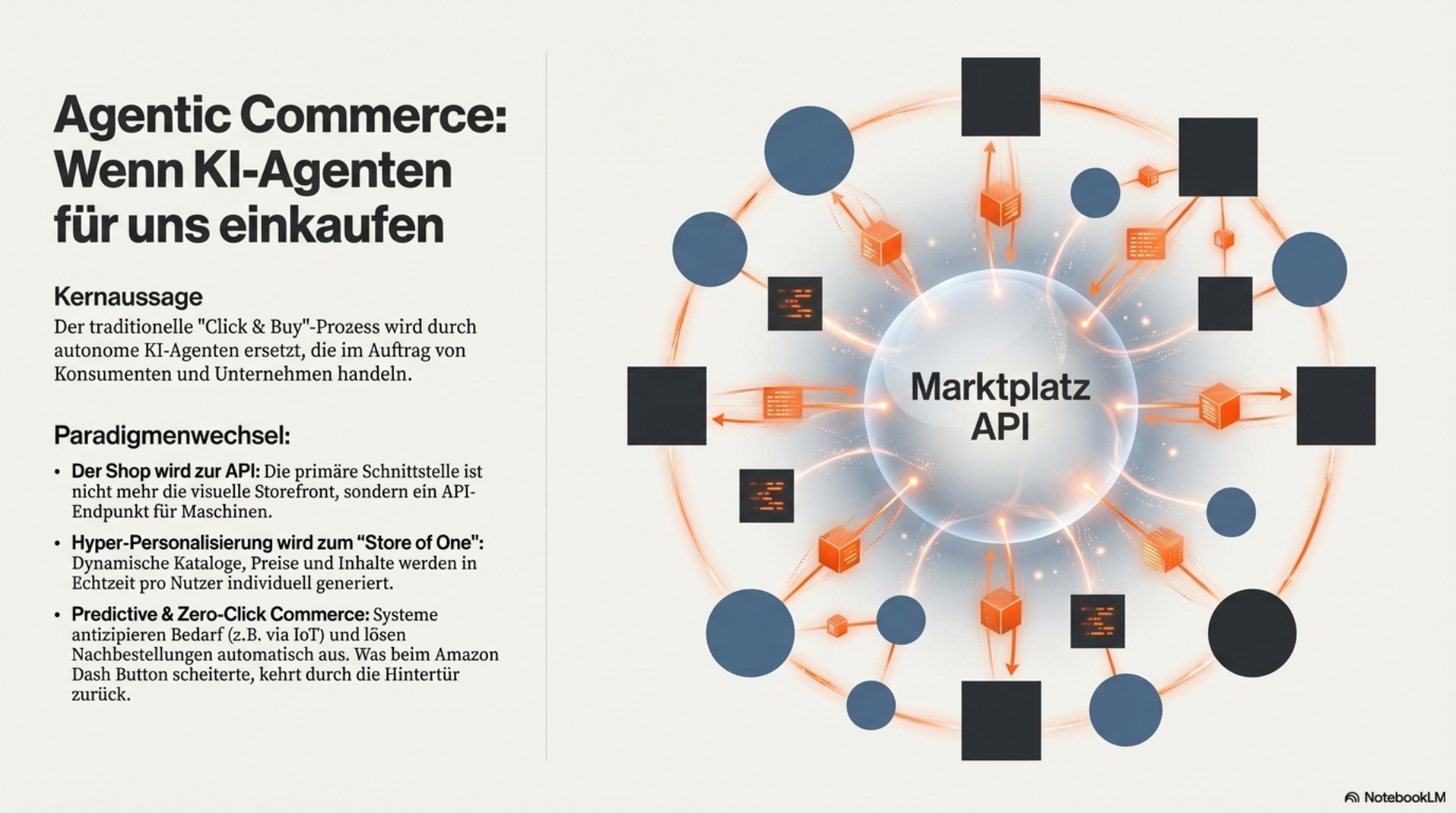
The most radical shift is the transition from traditional "Click & Buy" to agentic commerce. AI agents act on behalf of consumers and businesses:
- They search for products, compare offers and complete purchases autonomously.
- In B2B, purchasing bots increasingly negotiate directly with seller systems.
The webshop thus becomes less of a sales interface and more of an API endpoint for machines.
All relevant vendors in the market will have to offer solutions here.
We will see more working agentic commerce processes in 2026.
Hyper-personalization: The "Store of One"
Personalization reaches a new level in 2026. Shops respond to context and intent in real time:
- Dynamic catalogs and prices per user. I described an example in my article about the Adobe Technical Bootcamp in Barcelona Adobe Commerce Optimizer) in the Adobe Commerce Optimizer section.
- Individually generated content instead of static pages
The "Store of One" replaces traditional segmentation – with measurable effects on conversion and customer retention.
Predictive & zero-click commerce
E-commerce becomes increasingly anticipatory:
- Systems detect demand before it arises (for example through IoT sensors in B2B). What failed a few years ago, such as the Amazon Dash Button, is coming back to us through the back door.
- Reorders happen automatically, without an active purchasing process.
Buying becomes a background process – efficiency beats interaction.
Immersive commerce as a conversion driver
AR and 3D shopping move from nice-to-have to standard:
- Virtual try-ons and in-room visualization
- Higher conversion rates and significantly reduced returns
Immersion becomes a direct revenue metric.
Platforms, TCO and architectural decisions
These trends make the strategic platform question more pressing.
SaaS & low-code: Growth through convenience
Platforms such as Shopify benefit from:
- AI-powered low-code/no-code
- Fast time-to-market
- Low barriers to entry and predictable TCO
For many companies, this remains the fastest way to scale – particularly in D2C and the mid-market.
Composable commerce: Freedom at a price
For complex enterprise requirements (and only there!), composable commerce / MACH is gaining ground:
- Best-of-breed instead of all-in-one
- High flexibility and speed of innovation
The price is increasing complexity. Without proper governance, operating costs and dependencies grow. In 2026 too, merchants who do not need this complexity will choose a far too oversized solution and drive their plans into a wall.
On the other hand, the misconception that extremely complicated business models can simply be clicked together using standard platform features will also persist.
For simple business models, platforms such as Shopify will continue to dominate the market.
The countertrend: Data sovereignty & sovereign commerce
Alongside SaaS dominance, a strong countertrend is growing. Some will realize that they would rather have full control over their processes and data after all.
Sovereign AI & geopatriation
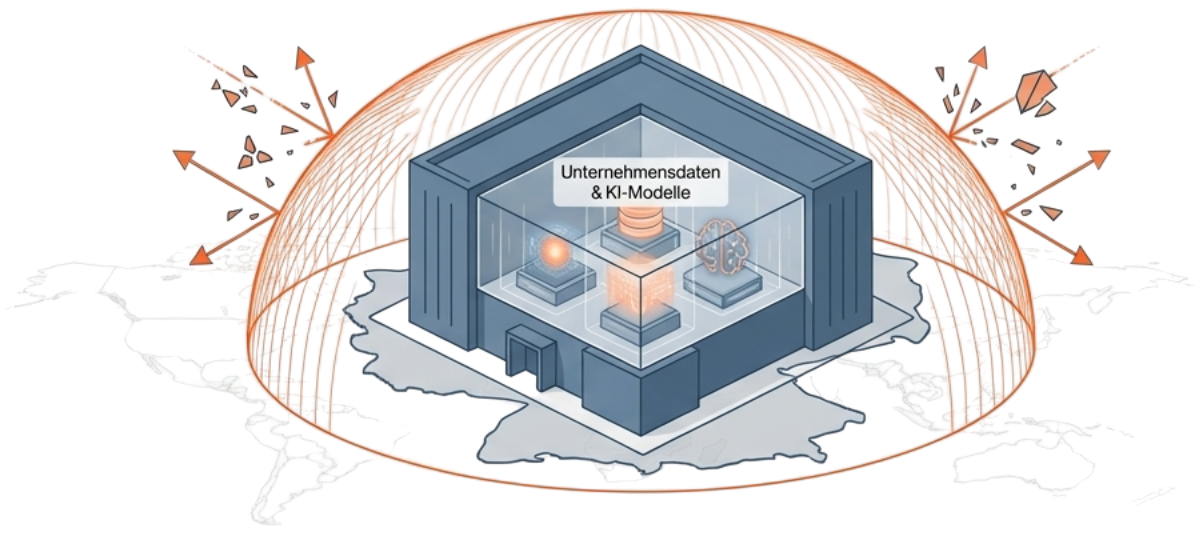
In 2026, companies increasingly prioritize:
- Data residency
- Control over models, data and infrastructure
- Independence from geopolitical risks
This is less ideology than risk management. Today, nobody can predict what politicians will decide tomorrow. Rules that applied in the past may no longer be valid tomorrow.
As a company, you need to assess the risks and, if necessary, regain data sovereignty. Processes will increasingly also be assessed according to which systems from which geographic regions are used. This will have its price, but companies will be more willing to pay it in 2026. Perhaps also so the CEO can sleep well at night.
Data governance as a competitive advantage
Data security becomes a deciding factor in purchases:
- Transparency about data processing
- Trust as a differentiator
As more and more criminal activity is observed, being a "Trusted Retailer" becomes a real asset. As a shop operator, I need to do more in 2026 to make customers feel safe and to ensure they really are safe. Topics such as buyer protection, certificates and trust seals, as well as clearly labeling information, are even more important.
Magento Open Source & Hyvä as a sovereign alternative
Since I work in this area myself, I also need to say something here about the Magento Open Source ecosystem.
Despite the widening "gap" between Adobe Commerce and Magento Open Source, I predict the following:
- Magento Open Source remains strategically important for medium-sized businesses and enterprises
- Hyvä reduces complexity, modernizes UX and lowers development costs
This creates a genuine alternative to global SaaS platforms – particularly for companies with regulatory or sensitive B2B requirements.
With the release of the Hyvä theme under an open-source license, Hyvä will increasingly become the market standard in 2026 as well. Perhaps this will also make the Hyvä theme the default theme of the Mage-OS fork in 2026. As a result, developing Magento extensions that are Hyvä-compatible will no longer be optional. In 2026, there will be even more solutions bearing a "Hyvä-compatible badge".
Adobe continues to push its SaaS initiative forward. Those who need the traditional monolith because they are not relying on a microservice landscape will increasingly gravitate toward Hyvä Commerce. More on that in the next section.
The e-commerce ecosystem: The great fork in the road
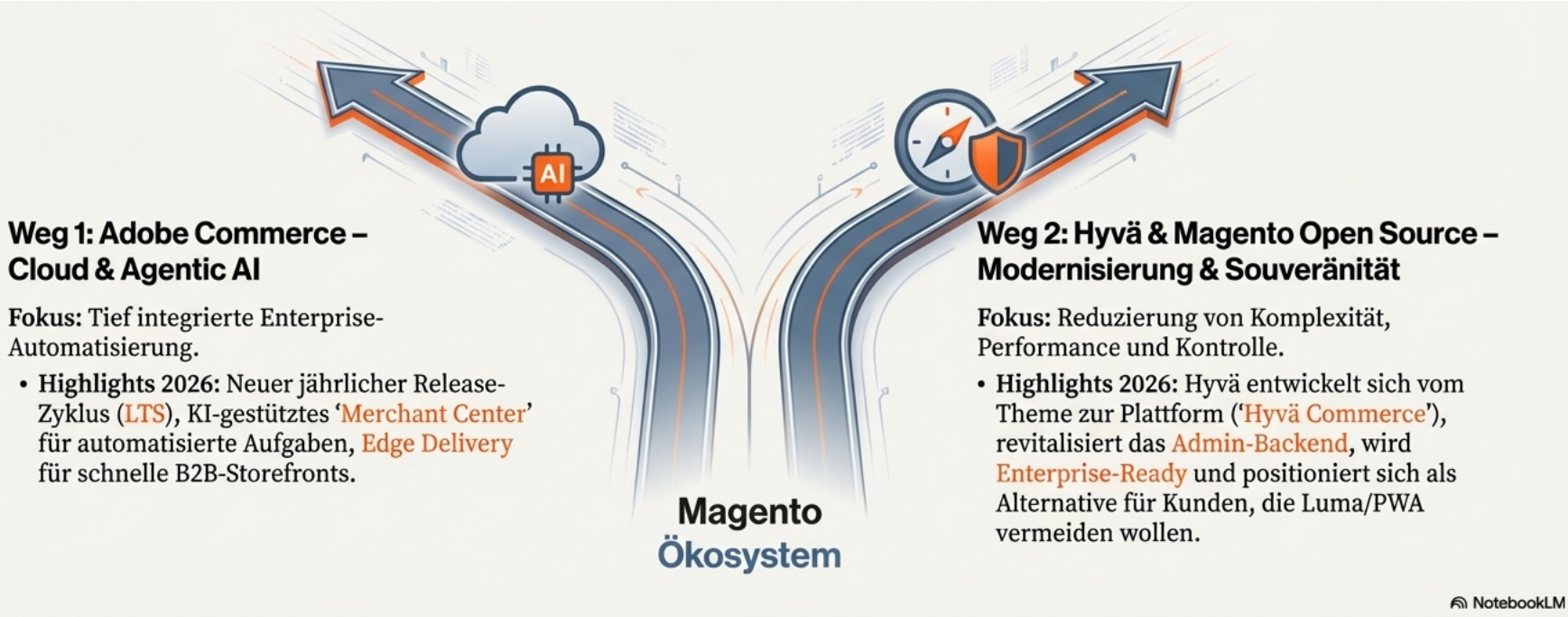
I deliberately wrote "fork in the road" in the heading rather than "split". From my perspective, a split has already happened. To me, two ecosystems already exist that still overlap through the Magento Open Source core. But their respective solutions serve fundamentally different target groups.
As someone deeply rooted in the Magento ecosystem, that is precisely why I find developments for 2026 particularly exciting. A clear division of the market into two branches is emerging: Adobe continues to focus on the enterprise cloud, while Hyvä modernizes the legacy of Magento Open Source.
Adobe Commerce: Cloud & agentic AI
Adobe is going all-in on enterprise automation and deeper cloud integration.
- New release cycle: Everything changes from January 2026. Instead of huge quarterly updates, there will be monthly, isolated security fixes. The major feature release (LTS) will come only once a year, in May. This is intended to smooth out "upgrade spikes" and make maintenance more predictable.
- Agentic commerce: The new "Merchant Center" will be an AI-powered command center. AI agents automate routine tasks – from configuring complex promotions to troubleshooting data synchronization. Adobe products are also increasingly converging visually in 2026. We will see this in Adobe Commerce too. The admin UI was already restyled this year. SDKs allow App Builder applications to look like any other Adobe application. This visual unification will continue in 2026, with the aim of presenting users with a unified system. Behind the scenes, however, the other systems will continue to work together through interfaces. The goal will be to hide these from users.
- Edge Delivery for B2B: "Drop-ins" will be introduced for B2B customers, enabling extremely fast storefronts – with features such as requisition lists and company hierarchies. Until now, EDS storefronts have focused primarily on B2C. We will see the first B2B cases in 2026. These B2B shops will be international and stand out with fast storefronts.
- App Builder: With native support for document databases, we developers can build data-intensive microservices directly in the Adobe ecosystem without having to provision external AWS infrastructure. My prediction for 2026 is not particularly exciting here. There will simply be more App Builder apps. Adobe continues working to make it easier for developers to transform existing Magento modules into App Builder apps. Many of these apps will not be visible in the Adobe Marketplace, however, because they operate in private environments.
Hyvä: From theme to platform ("Hyvä Commerce")
In 2026, Hyvä evolves from a purely frontend solution into a comprehensive platform extension that fills gaps Adobe (deliberately) leaves open.
- Admin dashboard: Hyvä revitalizes the backend with a new widget framework. Merchants can visualize and personalize data such as sales, Core Web Vitals or pending tasks directly in the admin panel.
- Enterprise-ready: Hyvä is working aggressively on compatibility with Adobe Commerce features such as "Negotiable Quotes" or "Gift Registry". This makes it a genuine alternative for enterprise customers who want to avoid Luma or PWA Studio.
- Checkout & performance: The checkout gets new layouts and login workflows. Image optimization tools also move directly into the core to reduce external dependencies.
Magento Open Source is alive
Contrary to all the doom and gloom, Magento Open Source remains relevant. Driven by the Hyvä ecosystem and the community (Mage-OS), the platform remains stable. Adobe's new patch model (an annual feature release) also applies to the open-source version, providing planning certainty through 2027/2028. Because a company such as Hyvä does not have to take care of the underlying platform, its employees can focus on innovative development. Adobe itself is no longer focusing on direct development through Magento modules. This is exactly where Hyvä Commerce will become the new standard solution and increasingly be perceived as a brand (shop system) in its own right.
Coding & data: The developer as orchestrator
Our role as developers is changing fundamentally. We are moving away from simply producing syntax toward orchestrating systems. I have written this several times in other blog posts. The traditional coder is needed less and less. This will be even more pronounced in 2026. More software architects will be needed. These architects will simply pass their wishes on to AI as instructions. Code review will still be done by humans. Even in code review, however, there will be increasing reliance on AI colleagues (because of competitive pressure). This will also cause problems. We will hear more about "AI mishaps" as code increasingly gets "waved through" unseen.
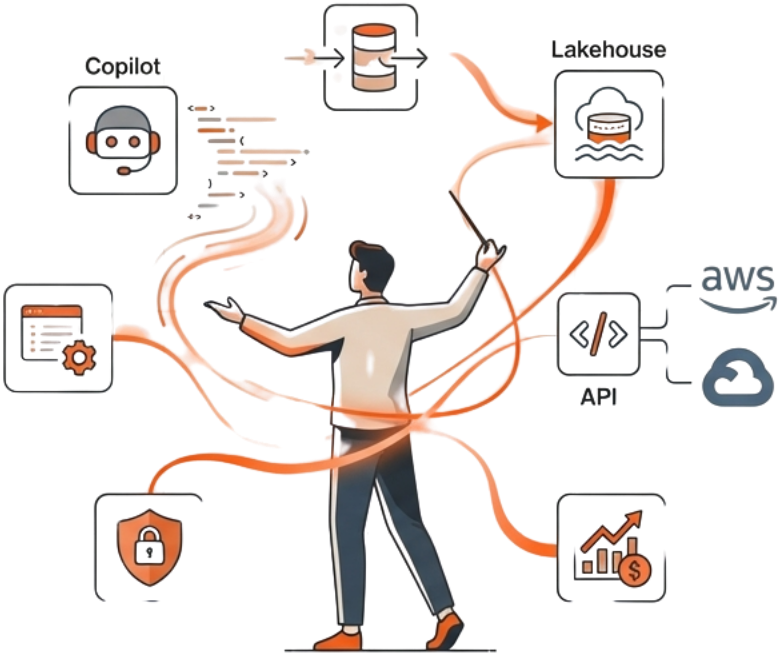
Safety mechanisms in development are needed here. All these topics were already present in 2025 and will occupy us even more in 2026. Since most developers are not doing things like Linux kernel development and often merely add to boilerplate code, the question of whether to use AI is no longer relevant. Developers who do not use AI will be replaced. Either by AI itself or by developers experienced in using AI tools.
Low-code/no-code vs. coding agents
One of the most-discussed questions for 2026 is: will low-code/no-code be replaced by generating code directly through AI agents? The short answer is: No – but it is changing fundamentally.
When AI makes coding easier than no-code
Traditional drag-and-drop no-code approaches are coming under pressure:
- Complexity vs. prompting: In many no-code tools, users have to model complex logic through nested menus. With AI-assisted coding, a precise prompt ("Create a sales dashboard in Python") is often enough, and near-production-ready code is created in seconds.
- AI-assisted coding: Tools such as coding agents, copilots or AI-enabled IDEs make writing code more accessible than ever. What matters is no longer knowledge of syntax, but an understanding of business logic.
- Vibe coding: A new paradigm is emerging in which people develop software without being traditional developers – they control AI agents through language. This model competes directly with the original promise of no-code.
AI-powered low-code
At the same time, low-code/no-code platforms are not disappearing, but evolving:
- Co-creation: Developers and business departments describe processes, data models or rules in natural language – the platform generates runnable modules from them.
- Intelligence, not just speed: Low-code becomes an orchestration and scaling platform with AI agents tightly integrated.
- Market reality: Forecasts assume that a large share of new enterprise applications will still be built on low-code/no-code platforms in 2026 – but with native AI at their core.
I work a lot with n8n myself. You can already see this very clearly in n8n. There are more and more integrations for developers to generate workflows directly through MCP servers. The cloud version also includes an AI assistant that can prebuild workflows directly from language, leaving you only to modify them.
Low-code platforms also allow pure code solutions to run. That is appealing, because you can still see the process visually. The two approaches are already merging here.
Low-code platforms will continue to be relevant in 2026. There will be more solutions generated by AI coding agents and integrated into low-code solutions.
More on that in the next section.
Why low-code/no-code remains relevant for businesses
Despite powerful coding agents, LCNC platforms retain strategic advantages:
- Governance & security: They provide guardrails such as architectural requirements, compliance checks and security scans for AI-generated code.
- Legacy modernization: Low-code remains the most efficient way to modernize old systems step by step using APIs, RPA and AI.
The essence: Low-code/no-code is not being replaced by manual coding, but expanded through natural language programming. Manually clicking things together becomes less important – natural language becomes the universal interface, whether within a platform or directly in the code editor.
In 2026, AI is the standard partner for coding. Routine tasks such as boilerplate code, tests and documentation are almost completely automated. We developers increasingly act as "architects" and reviewers of the generated code. The "vibe" I value so much in coding shifts toward solving complex architectural problems.
Data governance & FinOps
Data is the oil, but without a refinery and safety precautions it is useless. Since AI models are only as good as their data, data governance becomes a priority. "Lakehouses" (unified data platforms) become the standard for breaking down data silos. At the same time, FinOps for AI becomes a critical skill for data scientists: it is about strictly controlling the exploding costs of AI infrastructure (inference costs).
AI in everyday life in 2026: From chatting to acting
In 2026, AI finally leaves behind the role of a purely screen-based tool. We are moving from a phase where we interact with AI to one where AI acts for us, makes decisions and becomes physically present. AI thus becomes the invisible infrastructure of everyday life.
From assistant to digital "employee"
The most fundamental shift is the rise of agentic AI.
- Shopping & service bots: Consumers delegate tasks to personal AI agents that find products, negotiate prices and complete purchases. Decisions that previously required lengthy comparisons are made in seconds.
- Autonomous workflows: These agents plan trips, manage subscriptions or independently carry out financial transactions – within clearly defined user guardrails.
Work: Less monotony, more impact
AI changes not only what we do, but how we work:
- Focus on strategy: Routine activities such as invoice verification, reporting or coding scaffolds are automated. People focus more on problem-solving, creativity and decisions.
- Democratization of skills: AI-assisted coding and "vibe coding" enable non-developers to create software too, by describing their intent.
- The AI generalist: Basic digital skills become the new standard. People who can orchestrate different AI systems are in demand.
Hyper-personalization & zero-click experiences
Everyday digital experiences become highly individualized in 2026:
- Store of One: Online shops, content and prices are generated in real time for each individual person.
- Predictive services: Systems recognize needs before they are explicitly expressed – all the way to zero-click commerce, where reordering happens automatically.
Physical AI & immersive realities in everyday life
The boundary between the digital and physical worlds blurs:
- AR & VR: Virtual try-ons, immersive learning or therapeutic applications become commonplace, reducing friction and costs.
- Physical AI: Drones, delivery robots or assistance systems in hospitals and logistics become part of the normal urban and working landscape.
Invisible, secure transactions
Technology recedes into the background:
- Biometric wallets: Payment and identification happen through your face or fingerprint – quickly, securely and without conscious interaction.
- Instant refunds: Refunds run automatically and almost in real time.
Creativity for everyone
Creative AI goes mainstream:
- Users create, edit and personalize content with just a few instructions.
- Custom models and styles can be used without deep technical knowledge.
In short: In 2026, AI is no longer a separate feature, but a quiet, acting infrastructure that takes on tasks, provides physical support and delivers precisely tailored experiences – alongside growing expectations for transparency, control and trust.
Conclusion: The "AI generalist"
To sum up: the working world of 2026 is looking for the AI generalist. Specializing in a single programming language or a single tool is often no longer enough. Professionals are needed who:
- Orchestrate: Connect AI tools and autonomous agents into a functioning whole.
- Build bridges: Establish the connection between physical hardware (robotics & consumer devices) and digital intelligence.
- Take responsibility: Understand sustainability not as a burden, but as an optimization problem, and establish governance structures.
So things remain exciting. The tools are changing radically, but the need for creative problem-solving has never been greater than it is today. Let's get to it!