The rapid development of artificial intelligence has significantly influenced software development in recent years. Terms such as "prompt engineering" and "vibe coding" dominate the discussions. But while these approaches are promising for certain scenarios, the hype around omnipotent AI often leads to a distorted perception of reality. This blog post explores "context engineering" as a more mature and grounded approach that redefines the role of the software architect and software engineer and puts the development of large, production-ready applications back on a solid foundation.
Vibe Coding Only for Small Applications?
Before turning to context engineering, let's take a look at "vibe coding." This term describes the state of "flow" in which developers seamlessly solve problems and efficiently create code. It is programming that places not only pure productivity but also positive feelings and the joy of programming at the forefront.
Vibe coding, often supported by tools such as JetBrains Junie or Google Jules, is exceptionally well suited for:
- Small applications and prototypes (PoCs): Here, AI can quickly generate initial drafts, install dependencies, or perform simple migrations, such as migrating a Vue frontend from version 2 to 3.
- Repetitive tasks: AI can help eliminate "vibe killers" such as lengthy debugging or dependency updates.
However, "vibe coding" often leads to non-scalable prototypes when it comes to creating production-ready software. It is a way of working that focuses on feeling and rapid output, but not necessarily on long-term maintainability, scalability, or architecture.
Context Engineering
Context engineering is considered an evolution of prompt engineering. It aims to achieve better and more reliable results when creating code with AI. Unlike "vibe coding" or pure "prompt engineering," which focuses on optimizing individual requests, context engineering is a more comprehensive approach.
What Is Context Engineering?
Context engineering is an approach in which AI coding assistants are provided with comprehensive information, examples, best practices, and constraints in advance. It is an initial investment of time that can significantly accelerate the development process and lead to robust, production-ready applications.
This approach requires a deep understanding of the project requirements, existing codebase, and architectural guidelines. It is about telling AI not only what to do, but also how to do it, in alignment with the project's standards and goals.
The PRP Framework as the Core
A central concept of context engineering is the so-called PRP framework (Product Requirement Prompt).
What Is a PRP?
A PRP is a combination of:
- A Product Requirement Document (PRD)
- Selected information and examples from the existing code
- Clear step-by-step instructions for the AI on how to proceed with implementation (a "runbook")
It is intended to be the minimum package an AI needs to deliver production-ready code on the first attempt.
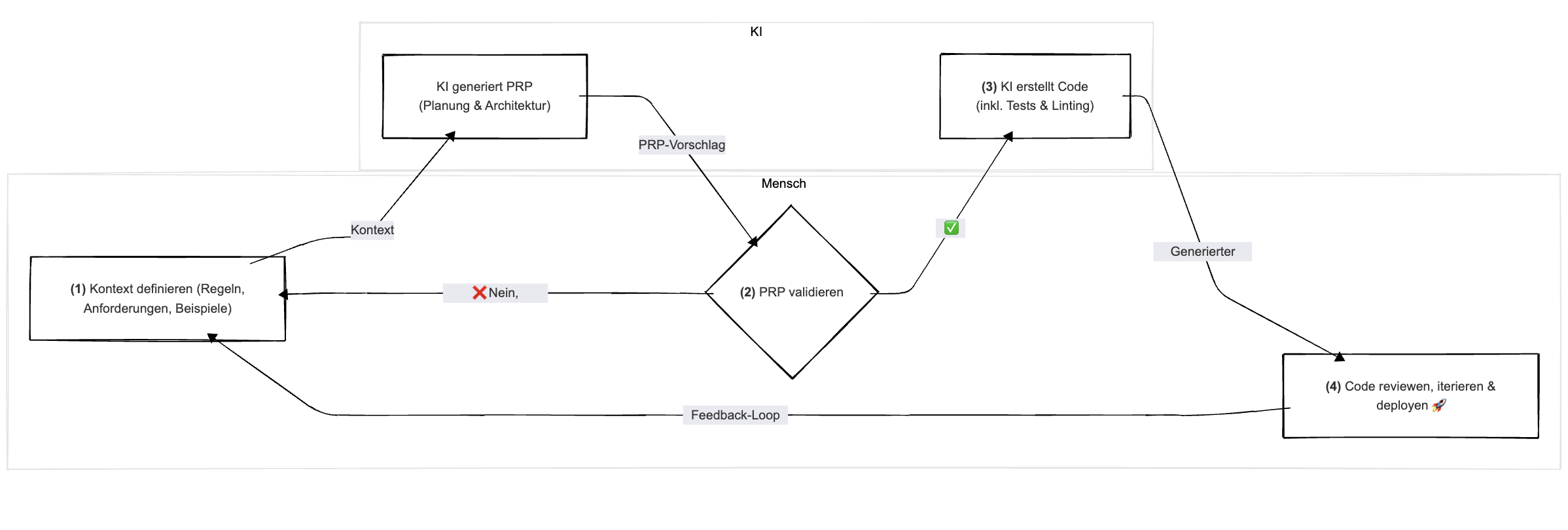
- Describe requirements: First, the requirements, functions, and examples are defined in a standard Markdown file (e.g.,
.md). - Generate PRP: A command creates a customized PRP from this, with AI handling research, architecture, and planning.
- Validate PRP: The generated PRP is carefully reviewed to ensure that it reflects the desired implementation.
- Execute PRP: After validation, the PRP is executed to create the code, including linting and unit tests.
- Iterate and deploy: The resulting code can then be tested, adjusted as needed, and deployed.
Global Rules vs. PRP Context
- Global rules: Constant principles that apply to the entire codebase are stored centrally—depending on the system used, this may happen in different formats or files.
- PRP: Contains the specific context for the task or feature currently being developed.
The PRP Approach
Iteration as a Central Principle
Context engineering is not a one-time configuration step, but a cyclical process. Every AI output is followed by a phase of validation and feedback. This feedback systematically feeds back into the PRP context—either through manual adjustment or automated feedback. This creates a continuous improvement process that becomes more robust and targeted with every iteration.
AI as a Temporary "Code Owner"
An advanced aspect of context engineering is the idea of temporarily assigning AI a form of "code ownership." Within a clearly defined PRP scope with strategic goals, architectural requirements, and test specifications, AI takes responsibility for design and implementation. This approach allows certain modules or features to be worked on as if by a dedicated AI team member—with clear handoff points for human validation.
Strategic vs. Operational Prompts
Within a PRP, strategic and operational prompts should be deliberately separated:
- Strategic prompts: Define the why and where to—in other words, goals, constraints, system boundaries, and quality requirements.
- Operational prompts: Formulate the how in detail—in other words, specific functions, algorithms, or technical tasks.
This separation helps AI make context-sensitive decisions within a stable strategic framework.
Context as an API Between Humans and AI
A strong conceptual idea is to understand the supplied context as a kind of API between humans and AI. This interface can be versioned, documented, and extended. Like traditional APIs, contextual interfaces enable controlled and traceable collaboration—but not between two machines, rather between humans and AI.
A neatly structured context with defined semantics, controlled terminology, and a known scope ensures that communication remains consistent and scalable.
The Software Architect's Domain
Context engineering is not a task that AI can take over completely. Quite the contrary: It requires sound expertise and strategic thinking of the kind typically provided by software architects and experienced software engineers.
Creating and maintaining the comprehensive information, examples, best practices, and constraints provided to AI is a demanding task. It is about clearly defining the system architecture, coding standards, security policies, and performance requirements and presenting them to AI in an understandable format. This requires a deep understanding of the entire system landscape and business goals.
Where "vibe coding" focuses on a quick proof of concept, context engineering focuses on:
- Scalability: Clearly defining context and rules allows AI-generated solutions to be integrated into large, complex systems without leading to chaos.
- Maintainability: The generated code is better aligned with the existing codebase and follows established conventions.
- Production readiness: Instead of short-lived prototypes, robust applications emerge that meet the requirements of a production system.
- Lower QA overhead: Structured guidance reduces errors generated by AI, decreasing the effort required for quality assurance and code reviews.
Tools such as Amazon Kiro have already been developed for context engineering.
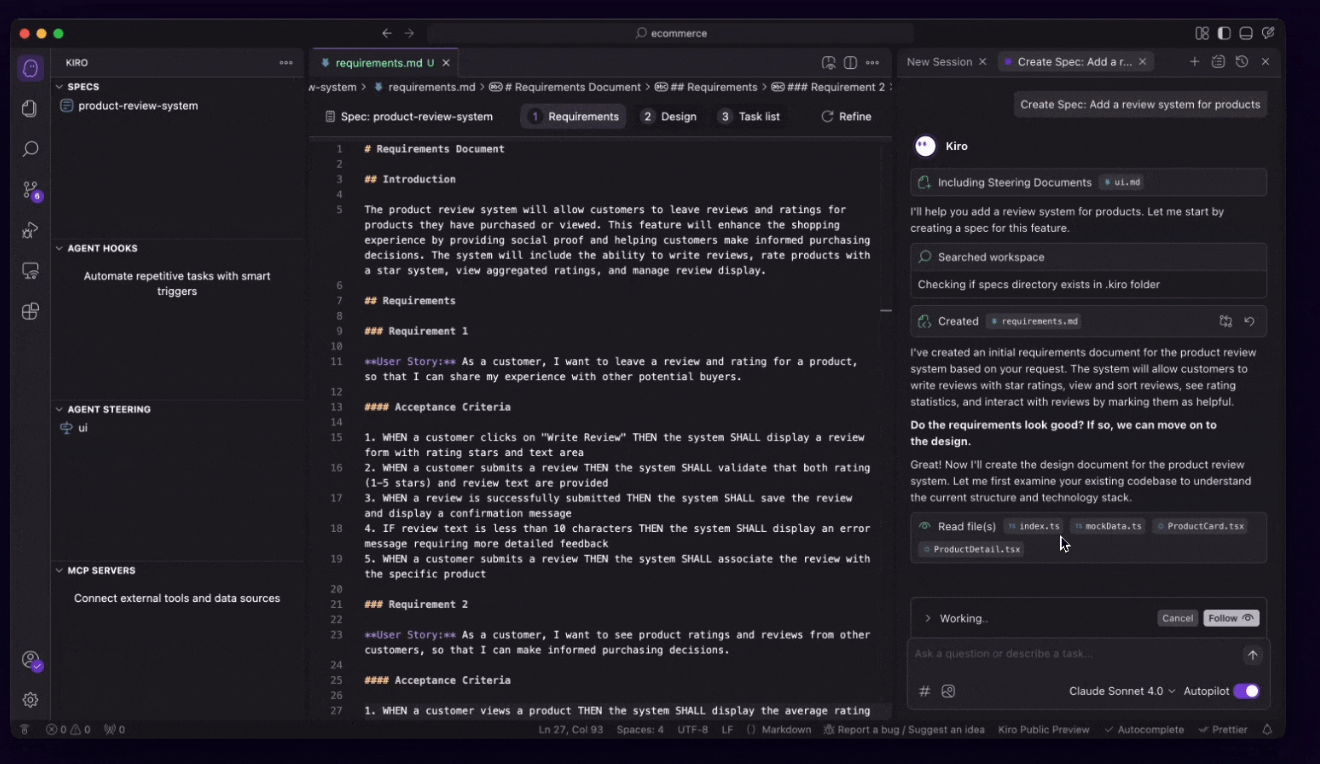 Image source: kiro.dev
A Realistic Perspective
The current "AI hype," which suggests that artificial intelligence makes developers redundant and "does everything itself," is misleading and potentially harmful. Context engineering demonstrates the opposite: AI becomes a powerful tool in the hands of experienced professionals.
AI is an excellent assistant for tasks such as writing boilerplate code, creating tests, or adapting code to new standards. It can significantly increase productivity and give developers room for more complex, strategic tasks.
But human expertise remains indispensable (for now):
- Requirements engineering: The ability to analyze and structure complex requirements and translate them into precise instructions for AI is a core competency of software engineers.
- Architectural design: Strategic planning of the system architecture, selecting the right tools and technologies, and defining interfaces and dependencies remain human domains.
- Validation and quality assurance: Critically reviewing AI-generated code, debugging, and ensuring overall quality require human judgment and experience.
- Handling complex problems: AI models (still) have limitations when it comes to abstract concepts, unexpected scenarios, or ethical questions. Sometimes AI models overcomplicate their solutions.
Context engineering is therefore a commitment to a more realistic and "honest" approach to software development in the age of AI. It emphasizes that AI is a collaborative partner whose potential can only be fully realized through targeted guidance and validation by experienced software architects and engineers.
A Look into the Near Future
In the near future, context engineering will become an integral part of modern software development processes. The development of collaboratively maintained PRP repositories with best practices, architectural patterns, and validated examples is already underway and is likely to become widely established soon.
Context engineering provides the methodological foundation on which AI-based development of production-ready software can be achieved at scale. The focus is no longer on short-term prototypes but on long-term maintainability, quality, and team enablement.
Speaking of teams ... It seems that teams will increasingly consist of architects and experienced developers. This increasingly raises the question: What role does a junior developer play in a team of experienced people and AI agents that can take over the work of junior developers? I do not mean developers who refuse to use AI, but those who are supposed to become the experienced developers of the future. At some point, we will have created a major shortage of emerging talent through AI.
Nevertheless, context engineering is the concrete next step after the sometimes wild prompting without content that leaves you starting from the same point over and over again.
Vision: AI as a Superior Development Partner

Let's imagine an AI two generations from now—a system that not only responds to human instructions but independently initiates, optimizes, and develops projects further. It has a profound understanding of code, architecture, business processes, and even user behavior—far beyond what individual developers can grasp.
This AI recognizes technical debt before it arises, prioritizes actions in line with business goals, and proposes architectural decisions based on global best practices. Its ability to process vast amounts of context and execute flawlessly makes it superior to human performance in many areas.
The human role shifts in this scenario: away from decision-maker and toward supervisor, ethicist, and source of creative inspiration. Humans review, correct, or question decisions prepared or made by AI—especially in cases calling for values, risk assessments, or empathy.
The software development of the future could therefore be heavily AI-dominated—with humans as partners and (hopefully) on equal footing in ethical, creative, and visionary questions. A new balance emerges in which we no longer tell AI how it should help us, but it suggests to us what is even possible.
OK, the future outlook described here is the very positive and optimistic version. But things could also turn out very differently. The issue of training young people already exists today. New professional fields are emerging, and jobs will disappear and be replaced.
Topics such as unnecessary AI use and energy demand, costs, and hardware availability will also play a role in determining the direction we can and will take. Cost pressure might mean that humans are not kept working as supervisors after all and algorithms are given more power because they simply make decisions faster. This is already a reality in high-frequency trading. Perhaps in the future, software will be programmed on the fly by an AI and executed immediately?
It remains exciting.