
In my last blog post, I described how my AI agent infrastructure continues to grow and handle increasingly complex tasks.
This brought up the question once again: Is a monolithic approach more effective, or does a distributed structure offer better advantages?
Disclaimer: This blog post of mine is a little different from usual. It is not intended simply to present a solution, or my solution. Instead, I want to share my thoughts with you. It contains many questions and considerations, but only a few answers.
So let's begin ...
An exciting concept that inspired me comes from Ben van Sprundel.
In his YouTube video, he describes an agent network consisting of a central management agent and several specialized sub-agents.
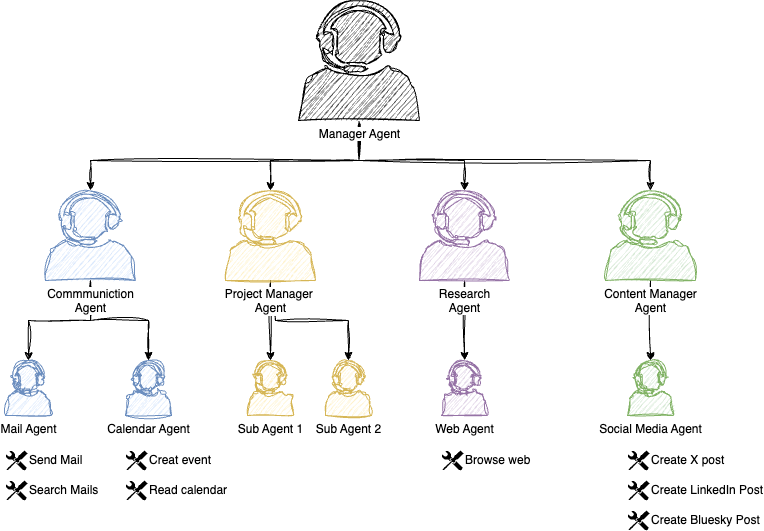
This structure encouraged me to think more deeply about the advantages and disadvantages of such approaches.
- Can a monolithic agent with many tools work efficiently over the long term with its large context, or will it eventually hit limits?
- How large can the context of an LLM (Large Language Model) be in order to manage numerous complex tasks?
- Does a distributed structure actually offer scaling advantages, or does communication between agents create new overhead?
- Can tasks be processed in parallel more effectively in distributed systems?
- Doesn't a kind of "communication ping-pong" arise in a distributed agent network that is less of a factor in a monolithic approach?
- How easy to understand does a system with several specialized agents remain, especially for more complex tasks?
- How much effort is required for fine-tuning, testing, and tracing communication in each approach?
So let's take a closer look at monolithic and modular architectures ...
The Monolithic Architecture: One Agent, Many Tools
Monolithic architecture is often compared to a Swiss Army knife – versatile but perhaps also a little
overloaded with features (?).
In this model, a single agent manages a wide range of information and tools.
(the following hypotheses still need to be tested)
Advantages:
- Simpler management:
Since all functions are centralized, communication is simplified. There is less "ping-pong" between different agents, enabling faster response times. - Minimized overhead:
Internal data processing eliminates much of the communication effort, increasing efficiency. - Unified context:
A central context allows the agent to tackle tasks with a deep understanding, without constant context switching.
Challenges:
- Limited scalability: How many tools can a single agent actually manage before it becomes overloaded? Growth often brings limits. When does the prompt become too large for the LLM?
- More complex updates: Every change affects the entire agent. (This can also become an advantage again during refactoring)
- Less flexibility: New requirements or functionality demand larger changes to the entire system, limiting adaptability.
The Distributed Approach: Flexibility and Specialization
The distributed approach stands in contrast to this. Here, work is distributed among specialized sub-agents,
such as a content manager or a communication manager.
Advantages:
- Scalability: Modular agents are easier to scale. New sub-agents can be added without overloading the overall system.
- Focused development: Each agent has a specific task and can concentrate on it. This makes adjustments and optimizations easier.
- Parallel processing: Different tasks can be handled simultaneously by sub-agents, increasing efficiency.
Challenges:
- Communication effort: How costly is the overhead of communication between agents, particularly with a large number of specialized units?
- Traceability: In distributed systems, it can be difficult to track communication between agents (see the telemetry section in the last blog post). Does this remain manageable in complex systems?
- Domain separation: Can every agent really handle its assigned tasks independently, or do too many dependencies create new problems?
A Balancing Act Between Flexibility and Efficiency
The choice of a monolithic or distributed architecture ultimately depends on the project's specific requirements.
In an environment where fast responses and simple management are the priorities, the monolithic approach could be superior.
But how many tools can a single agent actually manage efficiently?
Is the context of a monolithic system sufficient to handle increasingly complex tasks?
If, on the other hand, flexibility, extensibility, and specialization are needed, the distributed approach offers clear advantages.
But doesn't this structure also bring challenges, such as the risk of "communication ping-pong" between agents?
Can tasks really be processed in parallel more effectively in distributed systems, or does the increasing communication make efficiency harder to achieve?
The effects on scalability, testing effort, and communication traceability also need to be considered.
How much effort does it take to coordinate and optimize a complex distributed system?
And how easy to understand does a monolithic approach remain when it reaches its limits?
There are many open questions, and the right answer often depends on the project's specific requirements and goals.
Conclusion?
Choosing between monolithic and distributed architectures requires a close examination of project requirements
and long-term goals.
So far, I have not found a definitive answer as to which structure is best suited to my AI agent infrastructure.
In my initial tests, I was happy with the monolithic approach and was able to achieve some good early results.
At the moment, however, I am trying to combine the advantages of both approaches.
At first glance, combining the advantages of both approaches sounds appealing. But as always, the devil is in the details.
Right now, for example, I am struggling with agents repeatedly asking follow-up questions but sometimes getting no answer. In such cases, it is important
to set a limit on the maximum number of iterations so as not to end up in an infinite loop.
There is still quite a bit to test and optimize here. The prompt and, of course, the model can also play a major role and produce very
different results.
So, those were my thoughts on this topic. I hope this post has inspired you and given you food for thought.
I am certainly still doing a lot of experimenting and trying out both approaches myself.