
Over the past few months, one topic has occupied me more than any other in the e-commerce space: Agentic Commerce. AI agents that autonomously shop, negotiate, and pay — without a human clicking even a single button. It sounds like science fiction, but it is already reality. And anyone working in the Magento/Adobe Commerce ecosystem should take a closer look now. That is why this blog post also takes a look at the Magento ecosystem.
McKinsey puts the global market potential at US$3–5 trillion by 2030, while Gartner predicts that 90% of all B2B purchases will be handled by AI agents by 2028. At the same time, a sober look at the current data shows that the hype is far ahead of actual user adoption. OpenAI already switched its Instant Checkout in ChatGPT back to merchant apps in early 2026. German consumers would, on average, entrust an AI agent with no more than 50 euros per month.
In this post, I will try to unpack the topic systematically: what exactly is Agentic Commerce? Which protocols are gaining traction? Who are the relevant players? And what does this mean specifically for the Magento/Adobe ecosystem?
What Distinguishes Agentic Commerce from Traditional E-Commerce
The decisive difference is in the division of roles. In traditional e-commerce, the human actively searches, compares, and buys. In conversational commerce, a chatbot conducts a conversation, but the human decides. In Agentic Commerce, the human delegates — defining goals, budget, and preferences, while the agent acts independently within those guardrails.
Deloitte describes four evolutionary stages:
- Assisted Discovery — AI helps with product searches
- Agentic Shopping — the agent takes over individual steps autonomously
- Autonomous Shopping — fully independent purchases
- Agent-to-Agent Commerce — buyer and seller agents negotiate directly with each other, without a human ever looking at a screen
We are currently between stages 1 and 2. Stage 4 is the future — but the infrastructure for it is being built now.
The Protocol Stack: Not a War, but Layers
Initially, there was a lot of noise about a supposed "protocol war" between MCP, A2A, UCP, and ACP. The picture has since become more nuanced. The protocols are not competitors, but layers of a shared stack.
MCP — the Universal Data Layer
The Model Context Protocol (MCP), introduced by Anthropic in November 2024, has now become the de facto standard for how language models access external data, APIs, and tools. It works like "USB-C for AI" — a standardized interface, independent of the model vendor.
In December 2025, Anthropic handed MCP over to the Agentic AI Foundation (AAIF) under the umbrella of the Linux Foundation. Founding members include AWS, Google, Microsoft, and OpenAI — more than 10,000 public MCP servers are now registered. That is a strong signal of long-term stability.
A2A — Agents Talk to Each Other
Google's Agent-to-Agent Protocol (A2A), introduced in April 2025, enables agents from different vendors to discover one another and delegate tasks. The core concept is Agent Cards — JSON metadata at /.well-known/agent.json describing capabilities and authentication requirements. Essentially a business card for agents. It was also handed over to the Linux Foundation in June 2025 and now has more than 150 supporting organizations.
UCP vs. ACP — the Real Protocol Question in Commerce
This is the question occupying me most at the moment. My colleagues at valantic have published a worthwhile deep dive into the Agentic Commerce Protocol that does a good job of explaining the technical differences between the two approaches.
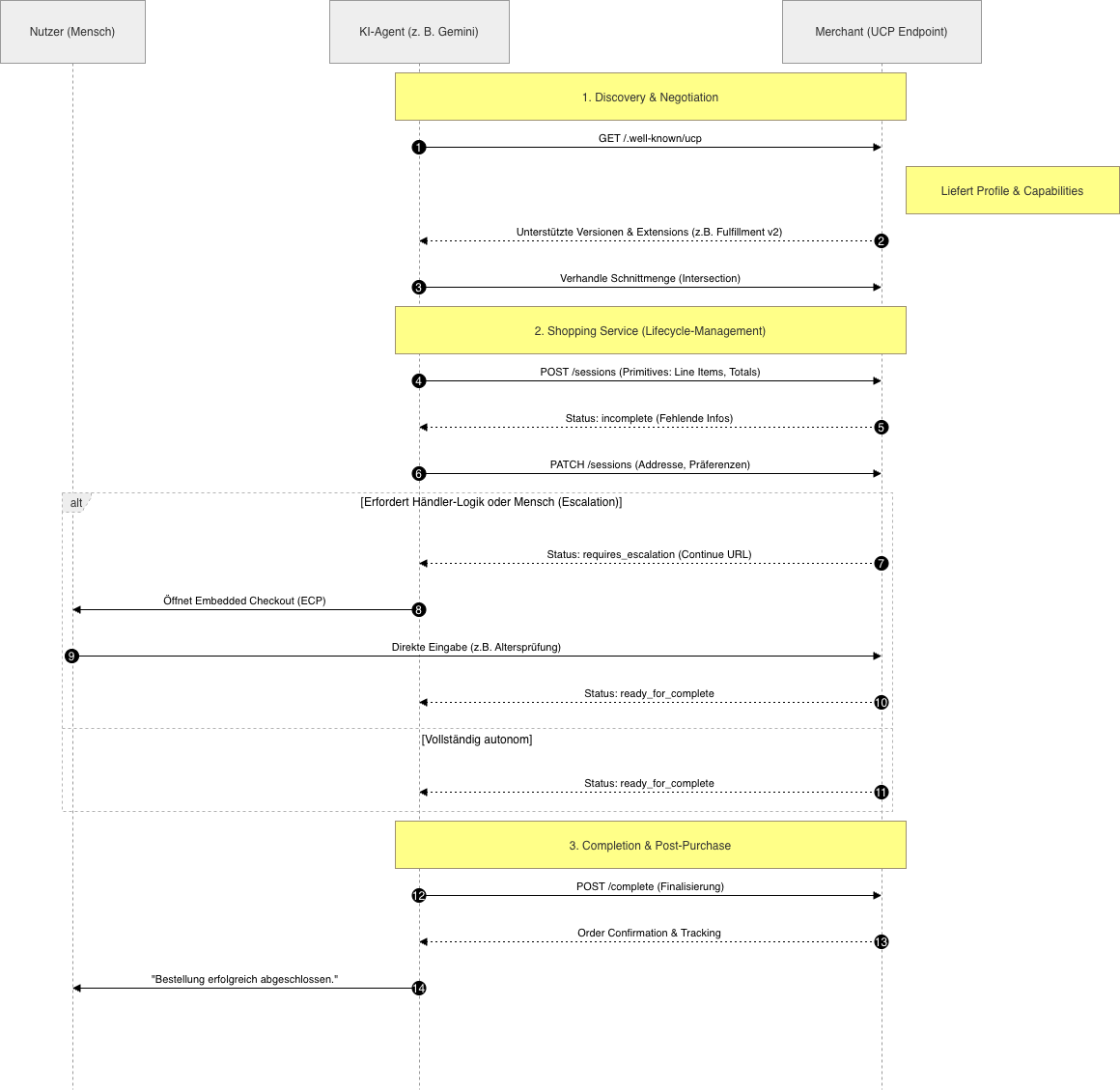
The Universal Commerce Protocol (UCP) was jointly introduced by Google and Shopify at NRF in January 2026. It covers the entire commerce lifecycle — from discovery through checkout to post-purchase support. Transport-agnostic, with REST, MCP, and A2A bindings. The coalition behind it is impressive: Walmart, Target, Etsy, Wayfair, Zalando, Mastercard, Visa, Stripe, and more than 20 other partners.
Universal Commerce Protocol: Checkout Sequence
-
Layered Architecture: UCP separates responsibilities into layers. The Shopping Service defines the basic building blocks (cart, status), while capabilities (Checkout, Catalog, Orders) and extensions (for example, specific delivery models) can be added flexibly.
-
Discovery via /.well-known: Similar to A2A, UCP uses a standardized path (/.well-known/ucp) through which agents can discover a shop's "capabilities" and negotiate which protocol versions both sides support.
-
State Management: A checkout in UCP passes through defined states: incomplete (missing data), requires_escalation (intervention needed), and ready_for_complete (ready to complete). This enables a seamless transition between AI automation and human interaction through the Embedded Checkout Protocol (ECP).
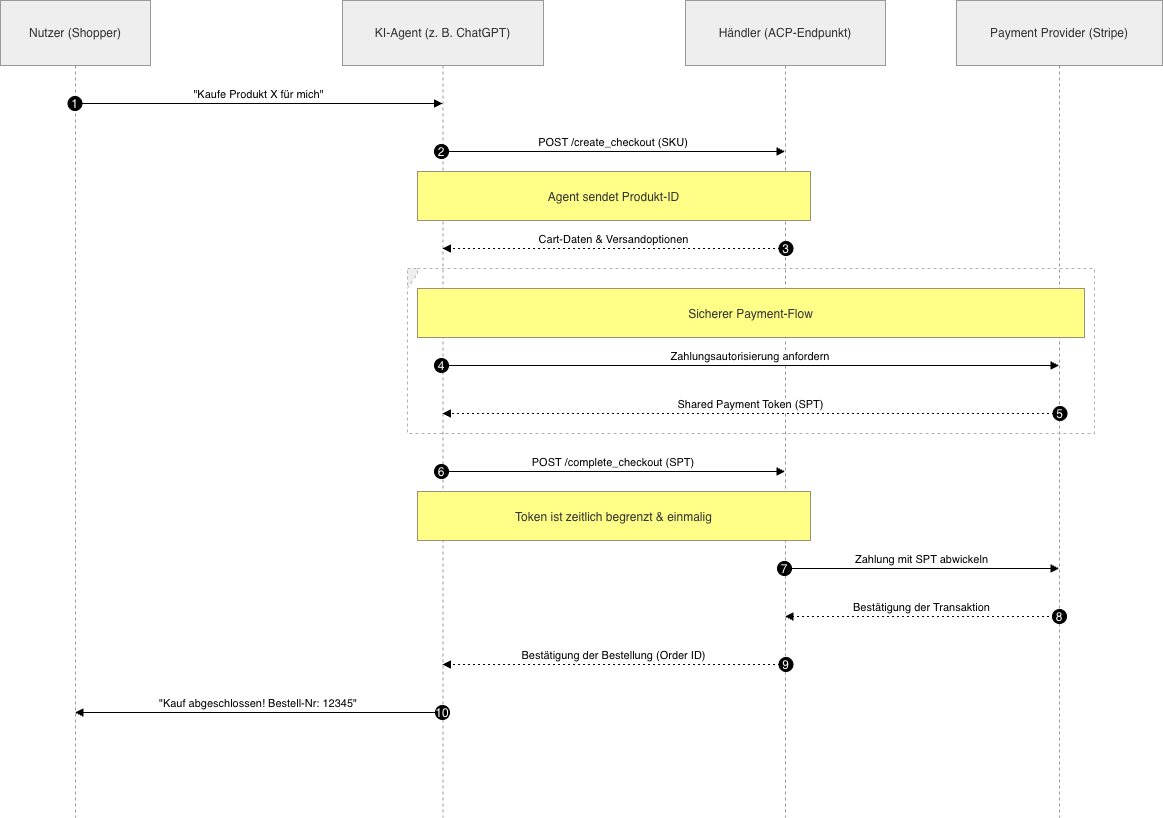
The Agentic Commerce Protocol (ACP) was developed by OpenAI and Stripe and powered ChatGPT's "Instant Checkout." However, OpenAI already adjusted this approach in early March 2026: the checkout process is increasingly moving into merchant-specific "ChatGPT Apps," because the complexity of commerce — dynamic prices, real-time inventory, tax rules — can be better represented in controlled merchant environments. Walmart reported conversion three times worse than directly on walmart.com.
Agentic Commerce Protocol: Checkout Sequence
- Minimalist Architecture: The protocol is limited to the four endpoints Create, Update, Complete, and Cancel Checkout, keeping complexity low for merchants.
- Shared Payment Token (SPT): This is the key security mechanism. The agent (for example, ChatGPT) never sees the user's actual credit card details. It receives only a "self-destructing," single-use token from Stripe, which it passes on to the merchant.
- Merchant of Record: In the ACP model, the merchant remains the legal seller ("Merchant of Record") and retains control over fulfillment, taxes, and customer support.
- Prerequisite: Merchants must provide their product catalogs in machine-readable form (Product Feed) and make their checkout logic accessible through the ACP interfaces.
Stripe and Shopify are strategically well positioned — both are represented in both camps. That makes them winners regardless of the outcome.
AP2 and ANP as Complements
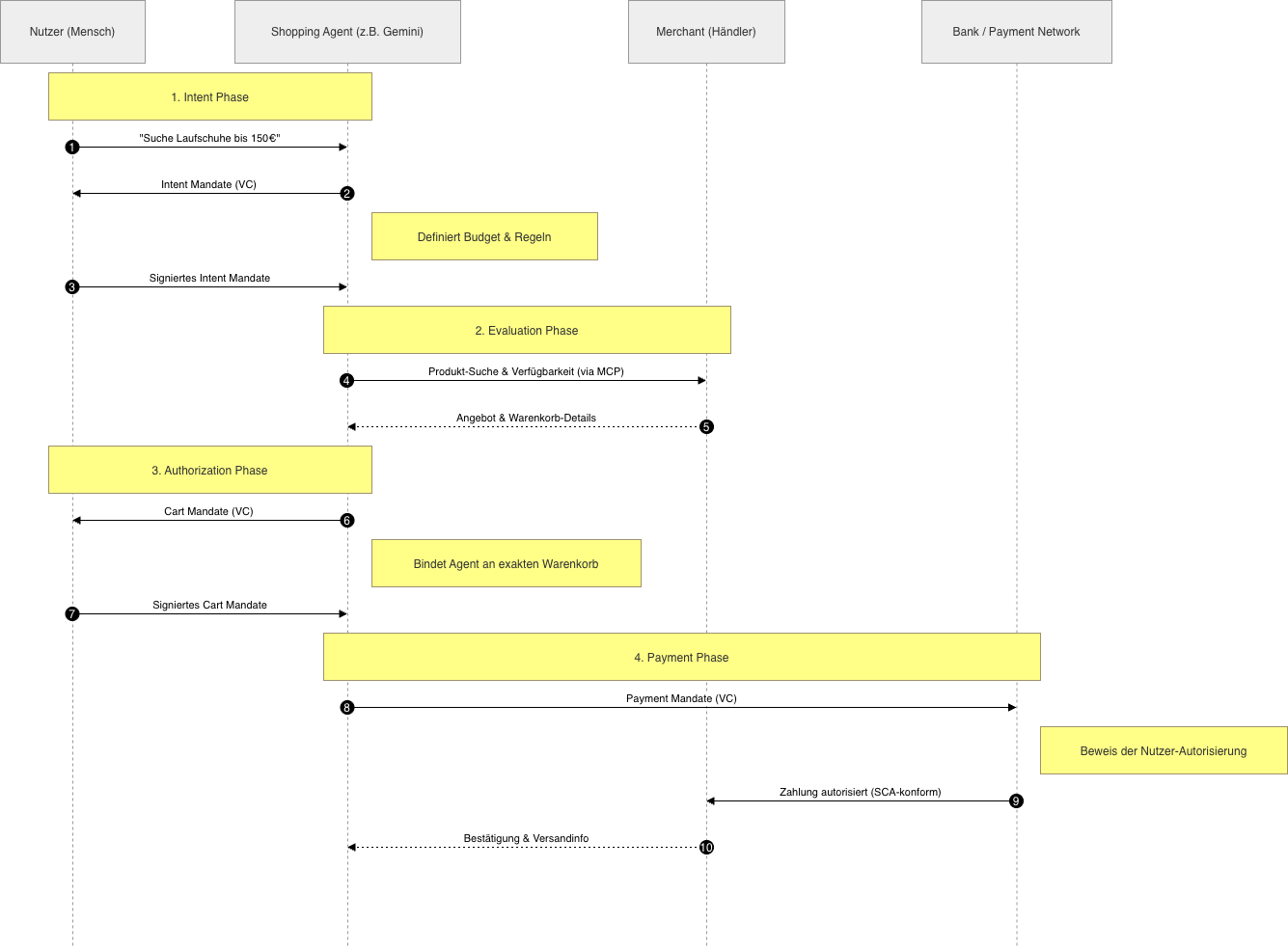
Google's Agent Payments Protocol (AP2) governs cryptographically secured payment authorization by agents, with three graduated levels of autonomy.
AP2 uses the concept of Verifiable Credentials (VC) to establish trust in autonomous systems:
- Intent Mandate (Intent): Gives the agent the task of searching and negotiating within specific guardrails (for example, "no more than €150"). It serves as proof that the agent is not acting on its own authority.
- Cart Mandate (Cart): This document is signed by the merchant and the user. It fixes the price and item quantity so that the agent can no longer change the price during checkout to the user's disadvantage.
- Payment Mandate (Payment): A minimal dataset transmitted to the bank. It signals to the payment network whether the user is currently present (Human-Present) or the agent is carrying out a preapproved ongoing task (Human-Not-Present).
The Agent Network Protocol (ANP) takes the most ambitious approach, with decentralized agent discovery via W3C DIDs — but without strong corporate backing, it is still significantly less mature.
In contrast to mostly client-server-based protocols such as ACP or UCP, ANP takes a radically decentralized peer-to-peer (P2P) approach. It is often described as the "HTTP of the Agentic Web" and consistently relies on web standards such as W3C DIDs (Decentralized Identifiers) and Semantic Web technologies.
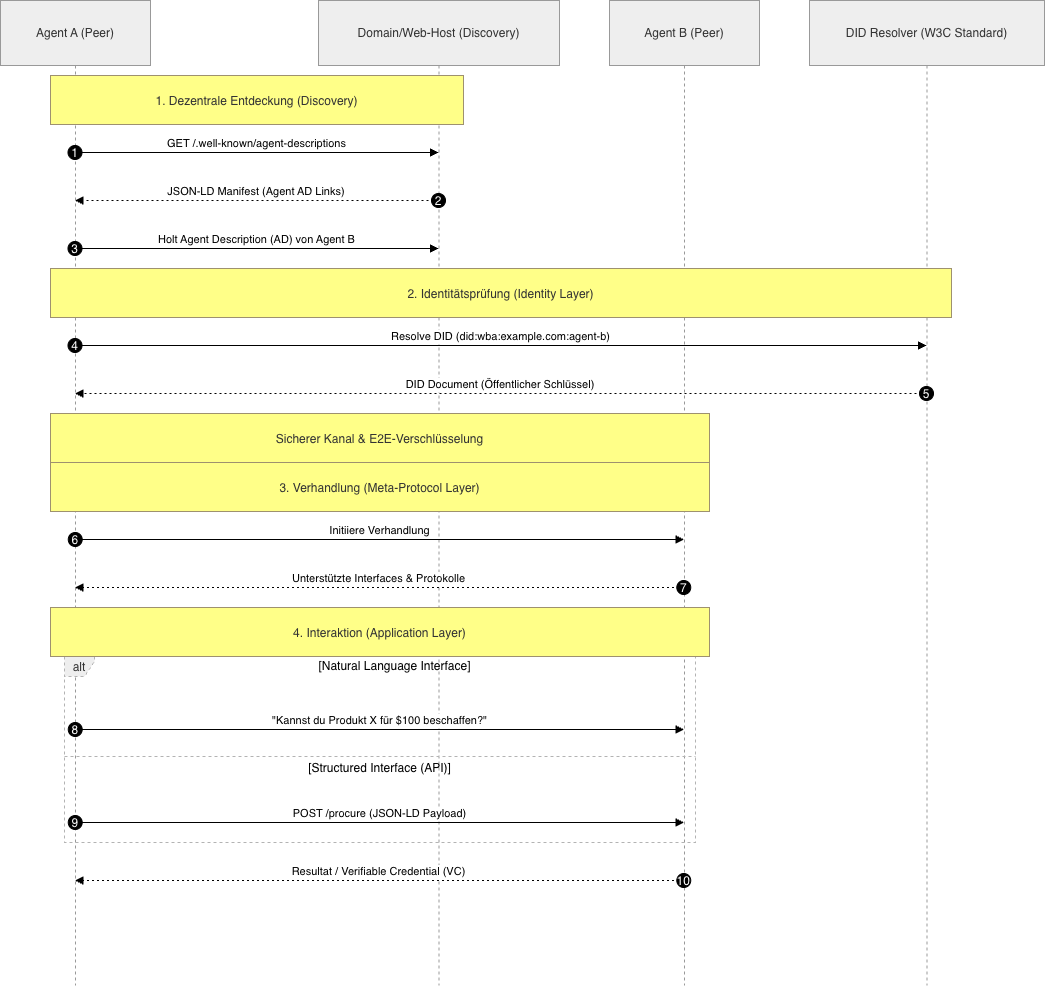
Mandate in the ANP Protocol
Computer Use as a Pragmatic Fallback
For the many websites without API integration, browser automation remains the fallback. Claude's Computer Use now reaches 72.5% on the OSWorld benchmark (up from 14.9% at launch). Slower and more error-prone than clean APIs — but ready to use immediately. McKinsey sees web crawling as an intermediate step before merchants implement standardized protocols.
Who Is Building the Infrastructure?
Shopify Has the Biggest Head Start
Shopify is the most aggressive player. Since the Summer '25 Editions, every Shopify store has its own MCP endpoint (your-store.myshopify.com/api/mcp). The Shopify Catalog categorizes billions of products for AI agents. Agentic Storefronts let merchants manage their brand presence on ChatGPT, Perplexity, Google Gemini, and Microsoft Copilot directly from the admin.
Particularly interesting: the new Agentic Plan explicitly opens the Shopify Catalog to brands on Magento, Salesforce Commerce Cloud, and custom stacks — without migration. That is an aggressive invitation to our community.
Google Is Building the Most Complete Stack
Google has its own protocols (A2A, AP2), a commerce standard developed jointly with Shopify (UCP), 50 billion indexed products in the Shopping Graph, AI shopping in AI Mode and Gemini, and a new enterprise platform with Kroger, Lowe's, and Woolworths as live customers. More than a billion shopping interactions flow through Google's interfaces every day.
Adobe Commerce Is In — but Not Live Yet
For our ecosystem, the situation is honestly mixed. Adobe officially announced support for UCP, ACP, and AP2 on February 18, 2026 — but not yet live shopping through AI platforms. While Shopify merchants are already selling through ChatGPT and Gemini, Adobe is still building its foundations.
Adobe cites impressive figures from the Adobe Digital Insights Report from January 2026: AI referrals achieve a 31% higher conversion rate, 254% more revenue per visit, and 45% longer time on site compared with conventional traffic.
Adobe's strategy has three pillars:
- Discovery Layer with the LLM Optimizer (GA since October 2025) — makes product catalogs discoverable for AI agents
- Agent-to-Agent Commerce Layer through UCP/ACP support (announced, not live yet)
- Brand-Owned Experience with Adobe Brand Concierge as a conversational AI layer on AEP profile data
The Adobe Commerce Optimizer is the most promising new product: a standalone commerce frontend on Edge Delivery Services with a Lighthouse score of 100, a GraphQL Merchandising API for agents and frontends, and a Data Ingestion REST API. Crucially: it works with any commerce backend, not just Adobe Commerce.
The AEP Agent Orchestrator platform (GA September 2025) is the technical foundation: 10 purpose-built AI agents, a reasoning engine, Agent SDK, and Agent Registry. More than 70% of eligible AEP customers already use the AI Assistant.
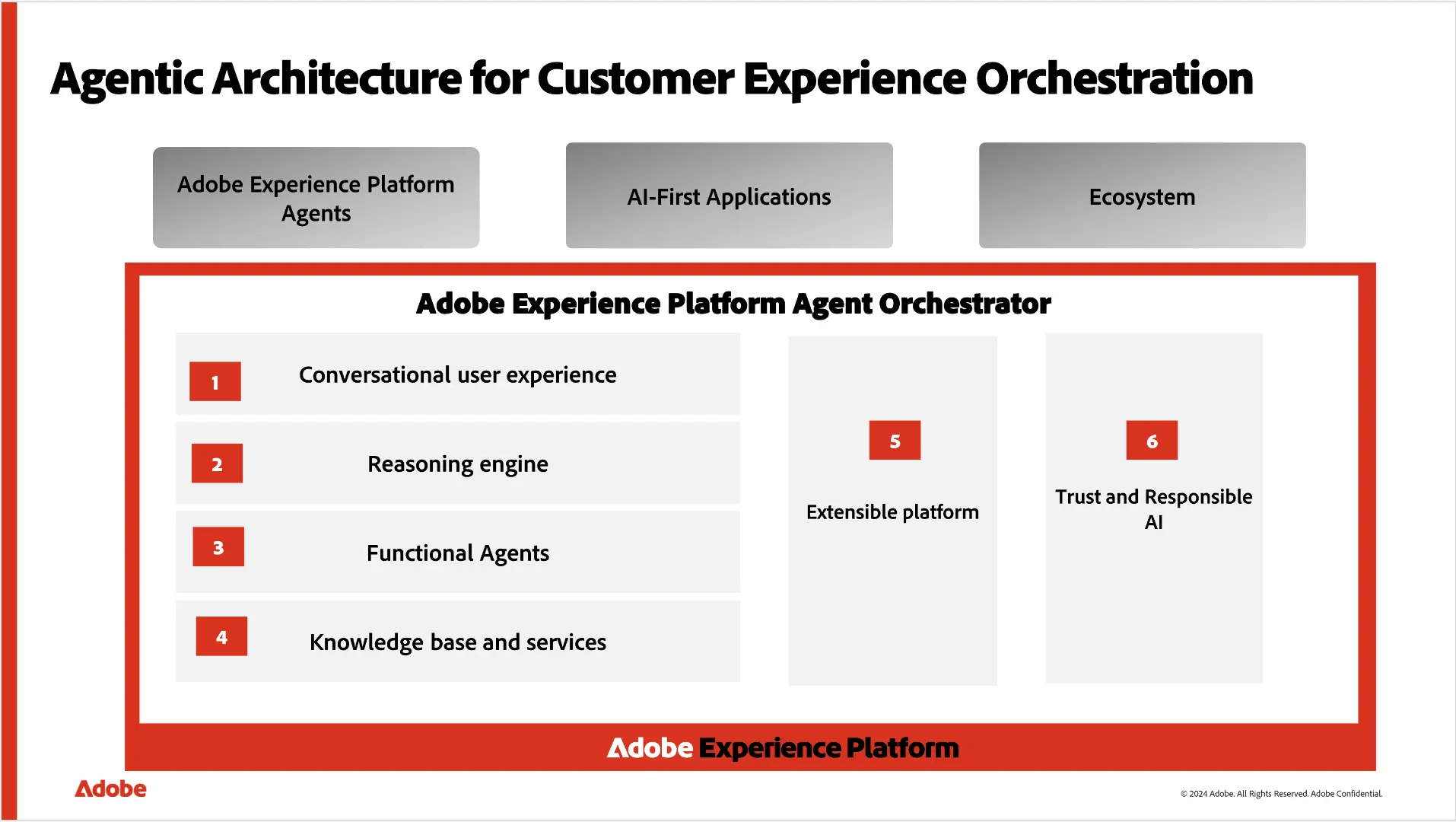
Image source: Adobe
The Magento MCP Ecosystem Is Alive
What positively surprised me: the MCP ecosystem around Magento is surprisingly vibrant. Alongside the official Adobe Commerce Extensibility MCP Server (with RAG access to the entire documentation and 7 AI agent skills), there are at least 10 community servers:
- Rafael Corrêa Gomes' GraphQL-based Dev MCP (Practice Director at Valtech)
- Mirasvit's commercial AI Agent Connector — enables commands such as "Discount all summer products that have not sold for 30 days by 15%"
- Freento's extension on the Adobe Marketplace
- Magenable Magento MPC for OpenAI Agent Builder
- Magendoo's REST and GraphQL MCP servers with 594 endpoints, and others
- mage-remote-run MCP - For completeness, I am also listing the MCP server of my own new tool here, which lets you flexibly connect any shops without installing anything in the respective shop.
The community reacts quickly. Whether that is enough to keep up with Shopify's native MCP endpoint per store — that is the question driving me.
ACP Modules for Magento 2: The Community Is Already Delivering
In parallel with the MCP ecosystem, the first open-source implementations of the Agentic Commerce Protocol directly for Magento 2 are emerging. Two projects I am watching:
run-as-root/ACP-for-Magento-2 is the more technically sophisticated of the two. The module from Würzburg-based agency run_as_root implements 95% of the OpenAI ACP specification: a full Checkout Session API with five endpoints, an ACP-compliant Product Feed (including variants, gallery images, real-time inventory), HMAC signature validation, idempotency key handling via Redis, and replay attack protection. Stripe integration for delegated payments is included, as are 39 unit and integration tests.
magebitcom/magento2-agentic-commerce-module comes from Latvian agency Magebit and describes itself as the first publicly available open-source ACP module for Magento 2. Its feature set is similar: ChatGPT-compatible Product Feed export, Instant Checkout, delegated payment via Stripe, webhooks. Importantly: the module is Hyva- and Adobe Commerce Cloud-compatible — crucial for many projects.
Salesforce and Amazon, for Completeness
Salesforce has closed more than 6,000 paid deals with Agentforce Commerce (GA November 2025). Its AI-powered Intent-Aware Search is based on a commerce-optimized Small Language Model. Salesforce's own data: AI agents influenced 17% ($13.5 billion) of holiday weekend orders in 2025.
Amazon operates a closed ecosystem with Rufus (300 million active users, an estimated $12 billion in incremental annual revenue) and the "Buy for Me" feature. All OpenAI crawlers blocked, not integrated into ACP or UCP. That makes 40% of US e-commerce invisible to external AI agents — a strategic decision that could prove costly for Amazon.
Stripe as the Payment Layer of Both Worlds
With the Agentic Commerce Suite (December 2025), Stripe has a complete solution: catalog syndication, checkout, payments, and fraud detection. Shared Payment Tokens (SPT) — single-use, revocable, programmable — solve the problem of how agents can pay securely without exposing payment details. In parallel, Coinbase and Cloudflare are advancing the x402 standard — optimized for micropayments in the machine-to-machine space. By March 2026, 50 million transactions had already been processed through it, averaging US$0.20 per transaction.
valantic explores what the shift means specifically for PSPs in a separate article: Agentic Commerce and Payment Service Providers.
What Agentic Commerce Means in Practice
Still in the Early Stages in B2C
Amazon's "Buy for Me" (in beta since April 2025), Google's corresponding feature in Gemini, ChatGPT Shopping with 50 million daily requests — the first wave is underway. Autonomous reordering by IoT devices, price comparison agents that scan dozens of retailers simultaneously and buy at the optimal moment — these are the first genuinely usable use cases.
According to Adobe, AI agents already influenced US$262 billion of global online revenue during the 2025 holiday season. AI-generated product recommendations achieve a conversion rate 4.4 times higher than traditional search.
The Real Leverage Is in B2B
This is where I see the greatest potential. Procurement agents monitor consumption signals, validate contract prices, and automatically place orders within budget limits. On the seller side, a sales agent responds dynamically, adjusts discounts and delivery terms, and completes the order — all within seconds. Gartner predicts US$15 trillion in B2B procurement by 2028 through AI-mediated purchases.
The Uncomfortable Questions: Trust, Liability, Visibility
What slows adoption is not the protocols — but trust and unresolved liability questions.
A Riverty/Adyen survey (1,000 Germans, December 2025) shows: 50% would entrust AI agents with no more than 50 euros per month. 46% associate AI shopping with skepticism. 93% demand the ability to inspect and stop AI decisions at any time.
The liability question remains legally unresolved. Who is liable if the agent buys the wrong thing? It will probably fall on the merchant. Add to that a 25% increase in malicious merchant activity related to Agentic Commerce (Visa) — fraudsters deliberately manipulate agentic shopping results.
And then there is Agent Optimization — the successor to SEO. If AI agents rather than humans are the first "customers," machine-readable product data, structured catalogs, and API-first architecture become necessary. Creatuity specifically recommends complete product attributes (technical specifications, materials, certifications), GraphQL coverage (reduces payload by 30–50%), and correct Schema.org markup. Gartner predicts a 25% decline in traditional search volume by 2026. According to Adobe, AI-driven traffic to US retail sites increased by 4,700% year over year in July 2025.
A central strategic question often goes unasked: will we even need our own webshops in the future? My valantic colleagues have put this into clear perspective: the webshop is not disappearing, but its role is shifting from the central entry point to the foundation of a connected sales system. Those running a modular, API-based architecture have a clear advantage.
My Conclusion (So Far)
Agentic Commerce is neither mere hype nor an immediate revolution — it is a fundamental infrastructure transformation, with adoption lagging behind the technology by 12–24 months.
For the Magento/Adobe Commerce ecosystem, I see a mixed picture: we have a vibrant MCP community, rich APIs, and a future-ready product in Commerce Optimizer. But the gap behind Shopify's native Agentic Storefronts is real — and the community is actively catching up, as the first ACP modules show.
What I recommend to anyone developing in commerce today:
- Evaluate an MCP server for your own shop — whether official, commercial, or community-built
- Test an ACP module — Magebit or run-as-root offer working starting points
- Optimize structured product data — Schema.org, JSON-LD, and machine-readable catalogs are the foundation
- Keep an eye on Adobe Commerce Optimizer — as a potential path to agent-ready storefronts
- Watch Shopify's Agentic Plan — Shopify is ahead here and should always be on your radar. That applies even if you do not use Shopify yourself.
The next 12 months will be dominated by low-consideration purchases — reorders, standard products, commodity electronics. The real disruption in high-engagement commerce will come later, but more slowly than the keynote slides suggest.
API-first is no longer a nice-to-have, but critical to survival. Those operating machine-readable, well-documented APIs today will be found by AI agents tomorrow. Those relying exclusively on human browser interaction will become increasingly invisible.
Further Reading
The topic is broad — here are a few articles by my direct colleagues that I recommend for getting an overview:
- valantic: Agentic Commerce — Interview and Perspective — What Agentic Commerce really means and where we stand today
- valantic: The Agentic Commerce Protocol in Detail — Technical deep dive into ACP and UCP
- valantic: Agentic Commerce and Payment Service Providers — What the shift means for PSPs and payment infrastructure
- valantic: Do We Still Need Our Own Webshops? — A strategic perspective on the role of your own shop in the age of AI agents